

by Hilary Bird, TARTU

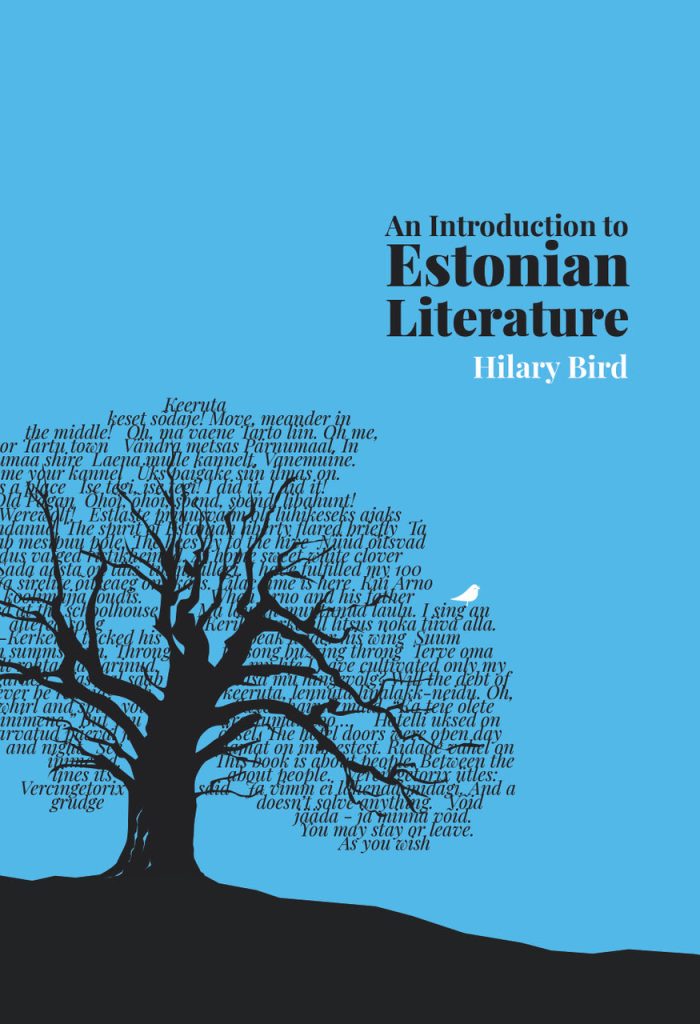
This article is extracted from An Introduction to Estonian Literature (Slavica Publishers, 2018), my historical anthology of Estonian literature from antiquity to the restoration of the independent Republic of Estonia in 1991. The scope of the book is wide rather than deep, and a long scythe cuts a broad swathe as the Estonians say. I exclude diaspora and post-1991 works that are, in an overall context, relatively well served by English language translations and commentaries.
To begin. Christianity and the written word developed in Scandinavia and Russia from 800 to 1200 AD but the eastern Baltic remained independent and pagan and, consequently, had no written culture. Writing arrived with Christianity after the Northern Crusades (1195–1410) but only for the victors. The lingua franca of the territory the colonists called Livonia was German, and Latin was the language of their church. Estonian-speakers became serfs excluded from education, literacy and social mobility and, bar a few place names and phrases and some Polish Jesuit 16th-century Counter-Reformation texts from Tartu, there was no written Estonian. This did not, of course, mean that the Estonians had no poetry or song but that their culture was oral. Estonian folk verse (regivärss) is characterised by trochaic tetrameter metre, alliteration, assonance and repetition. It is assumed to have been created by women because its tone is predominantly lyrical and addresses subjects traditionally associated with women – home, children, relationships, work, nature, community and joy. The first written Estonian folk song surfaced in a witchcraft trial in 1680. The first printed regivärss appeared in a popular calendar of 1829.
Estonian-speakers were separated when Catholic Livonia fell and conquering Sweden created two provinces – Estland and Livland (now Latvia and south Estonia). Lutheran Sweden was determined that its colonies would be able to read the catechism and the Bible in their own tongues. Written Estonian script was devised, textbooks written and printed and in 1687 an Estonian-speaking köster (assistant to the pastor) was assigned to parishes to check basic literacy. Reading material consisted of clerical handbooks with sermons and hymns and peasant primer books, but Swedish policy established a custom of learning to read in the peasant home. Scholars at the University of Tartu, established by Sweden, speculated that everyone spoke Estonian before the Flood, and wrote Estonian verse for special occasions. Rhyme from Germany proved popular and is used in the first written poem by an Estonian in Estonian. “Ah me! Poor Tartu town!” (Oh, ma waene Tarto liin, 1714) by köster Käsu Hans laments the 1708 razing of Tartu by the Russians. After 500 years of German rule, Hans still calls the town “Tarto” and not “Dorpat” (its German name); the complete poem was first published in 1902.
Livland and Estland became Russian provinces after the Great Northern War (1700–1720). The Baltic Germans were a useful “window to the west” for Peter I (the Great). They kept their hegemony and Lutheran faith, ensuring that, unlike those of Orthodox Russia, Estonian peasants remained literate. Throughout the 18th century, the Bible, primers, calendars and didactic storybooks reflected, however faintly, cosmopolitanism and reform. Pastor Freidrich Willmann’s Fables and Tales (“Juttud ja teggud”, 1782) included Aesop (respected by Martin Luther as second only to the Bible), The Decameron, La Fontaine, Voltaire, German fabulists, the Arabian Nights and a Pocahontas-type North American tale. Willmann’s stories appeared alongside astrological weather forecasts in cheap calendars, the major format for peasant readers until the 20th century: around one third were assimilated into folklore.
The activities of the established Lutheran church were complemented by revivalist Moravian missionaries invited from their headquarters in Hernhutt, Germany to “civilise” the peasants in the unstable aftermath of the devastating Great Northern War. The “Brethren” learned to speak Estonian, built their own
chapels, elected their own officials and formed choirs and brass bands. They preached quietism, self-sufficiency and a belief in “awakening” (renewal) – customs and values that flourish in Estonia to this day. The Moravians suppressed pagan folk traditions, but they taught reading and writing and, following a successful visit to Tallinn by their leader Nikolaus von Zinzendorf in 1739, the Bible in Estonian appeared, a major event that introduced north Estonian as the standard language.
Rational enlightenment arrived with Pastor August Hupel’s translation of Dr Peter Wilde’s A Little Learning (“Lühhike öppetus”, 1776) a self-help health manual for humans and cattle. Its patriarchal but humane approach to the peasants subsequently combined with academic change to create the Estophile movement. Mixing enlightenment and romanticism, the Estophiles believed with Johann Herder that a mother tongue was the manifestation of a volk worthy of serious study. The reopening of the University of Tartu in 1802 as a German institute on Russian soil was important. Estonian language courses (using Hupel’s textbook) were on the curriculum. Linguistic development was enhanced after 1809 when Finland was annexed into Russia. Finnish and Estonian are closely related Finno-Ugric languages and linguists and folklorists of the Estophile and Fennoman movements now rediscovered common cause (lost when Russia had conquered formerly Swedish territory in the Great Northern War) in joint research of their indigenous languages. Both Helsinki and Tartu universities adopted the Prussian higher education model of Wilhelm Humboldt, with scholars treating Estonian linguistic and folkloric studies as academic disciplines. Pastor Johann Rösenplanter’s journal Contributions to a More Exact Knowledge of the Estonian Language (Beiträge, 1813–1832) addressed linguistics, pedagogy and ethnography and, in 1822, the Beiträge published a translation (from Swedish to German) of Christfrid Ganander’s Finnish Mythology (1789) that introduced a Balto-Finnic mythology including the giant Kalevipoeg. More about Kalevipoeg later. The translation was by Kristjan Jaak Peterson, the son of an Estonian köster, a Tartu university student and the first advocate of a literary Estonian. Peterson wrote Estonian poetry and expressed a hope for appreciation of his mother tongue when this was no more than a pipe dream. His poems were first published a hundred years after his death in 1922. Kristjan Jaak’s birthday, 14 March, is now Mother Tongue Day.
The creation of a national epic, a cornerstone of Humboltian ideas, and inspired regionally by the Finnish Kalevala, was championed at the Estonian Learned Society (ELS; Õpetatud Eesti Selts in Estonian; Gelehrte Estnische Gesellschaft in German, founded 1838) by Dr Georg J. Schultz, Estophile and censor of the Baltic provinces, to encourage Estonian character building after emancipation from serfdom (1816–1819). The epic was written by Dr Friedrich Faehlman and Dr Friedrich Kreutzwald, Estonian graduates from the University of Tartu with a belief in written Estonian literature and the skills to write it. Both benefitted from the opportunity for social mobility that began with cameralist laws for Estland and Livland (1802–1804) aiming to create literate government administrators. To facilitate this aim, a ladder was created from Estonian-language village school to German-language town secondary school to university. The Emancipation Acts (1816–1819) made peasant schools and a village schoolmaster (though not school attendance) mandatory.
The regivärss national epic Kalevipoeg (“The Son of Kalev”) created a national hero, a king of ancient Estonia, out of a popular folk giant. Despite its being an academic work seen by only ELS scholars, almost 20% of the first version (1853) was deemed “nationalistic” and mention of “happiness” in precolonial days and the “lucid language of Estonia” were censored. The first popular edition of Kalevipoeg was printed in Finland, where censorship was lighter, in 1862, and thereafter censorship fostered a deep tendency towards symbolism.

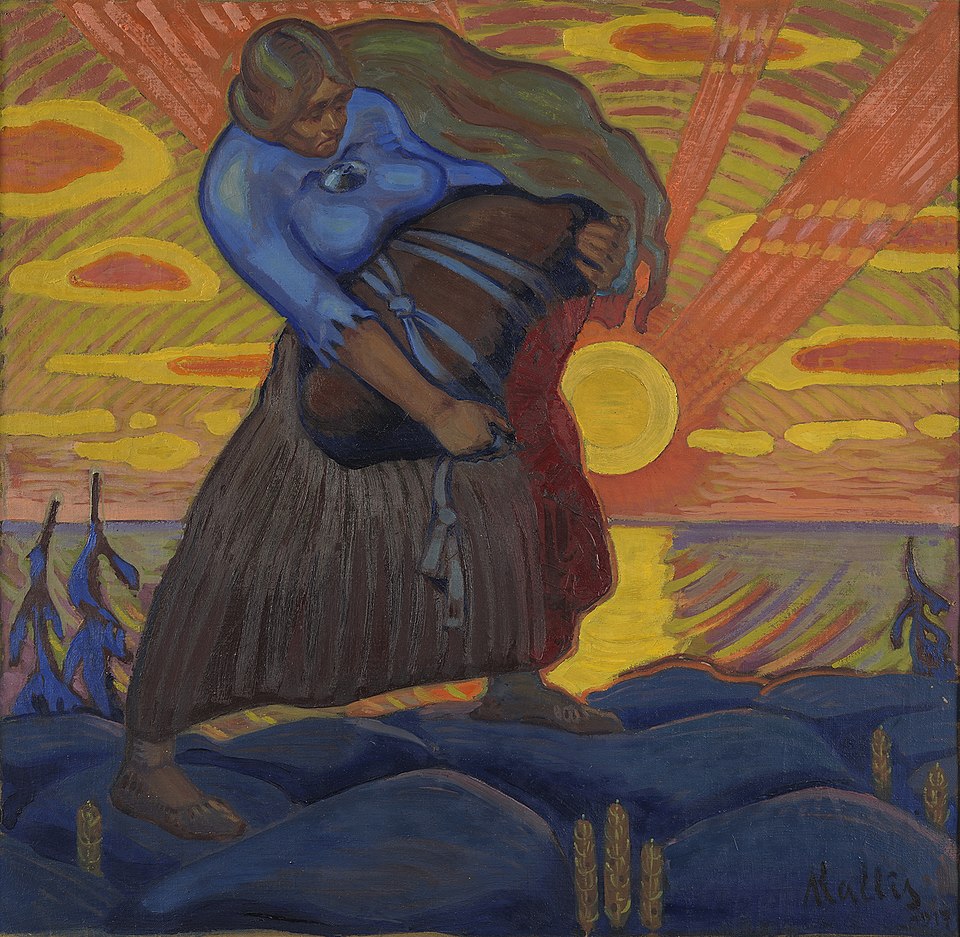
Estonians began to see themselves as a nation during the National Awakening (Ärkamisaeg, 1850–1890). Books and newspapers in Estonian appeared after censorship eased in 1855. Johann V. Jannsen, the first Estonian journalist, was one of many activists – Kreutzwald, Jakob Hurt, Carl Robert Jakobson – influenced by the Moravians. In 1857 Jannsen replaced the generic word maarahvus (“the peasants”) with the specific Eesti rahvas (“the Estonian people”) in the first Estonian-language newspaper, The Pärnu Post (Pärnu Postimees). Jannsen had given the people a name.
The reportage, instruction, popular science and belles-lettres of the Awakening was disseminated through a burgeoning network of Estonian-language Lutheran elementary schools – in Estland the number of children attending such schools doubled between 1866 and 1869. A critical factor for development was the emergence of an increasingly wealthy strata of Estonians. Early-19th-century legislation had decreed schools but the peasantry was expected to pay for them. Endemic poverty made progress slow. Agricultural reforms, especially the transition from labour-rent (corvée) to money-rent (1849–1856/60), gave Estonians the opportunity to buy land and keep what they earned. The result was a property-owning class of farmers able and willing to pay for schoolhouses and teachers trained to professional standards at the new training colleges. A boom in the international price of flax helped.
Poetry dominated the Awakening, especially the work of Lydia Koidula. Koidula voiced sorrow for Estonia’s past and hopes for its future, popularised the Kalevipoeg myths and founded a national theatre with her amateur comedies for the Vanemuine Society in Tartu, one of many societies now promoting Estonian-language culture. The lyrics of the two songs in Estonian (the other 25 were in German) that were sung at the first Estonian Song Festival (1869) were poems by Koidula – “Until Death” (“Sind surmani”) and “My Beloved Fatherland” (“Mu isamaa on minu arm”). “Mu isamaa” became the unofficial national anthem during the Soviet era, sung at the close of the national song festivals, whether this was permitted or not. Koidula also started a trend for prose about fights for freedom. Most were set abroad but The Avenger (1880) by Eduard Bornhöhe was set in medieval Estonia; its sympathy for Estonian rebels made it a bestseller.
Neither the Baltic Germans nor the Russians welcomed the emergence of the Estonians as a self-sufficient national community. Dr Schultz, a “Kalevipoeg godfather”, regarded himself as a paternalistic Kulturträger (“culture-bearer”) German who wanted to improve life for Estonians. Schultz did not envisage representation of the lower orders in government, and he clashed with teacher, writer, journalist, educationalist, political activist and major Awakener Carl Robert Jakobson, who advocated ethnic Estonian participation in the provincial legislative assembly (Landtag). The expectation of liberals such as Schultz was that socially mobile Estonians would assimilate into the German-speaking class and that the Estonian language would die out. The Awakening, however, generated a powerful Estonian-language-based identity that prevented wholesale Germanisation or Russification. Literature was central to this. All
factions of the Estonian community agreed upon the survival of the language and the importance of literature. The Estonian Writers’ Society (Eesti Kirjameeste Selts) was founded in 1871. Its most important (and successful) aims were the standardisation of the language and collection of folklore, a collection that formed the basis of the Estonian National Museum in 1909. The annual output of printed material increased nearly sixfold between 1840 and 1900. Calendars could contain up to 200 pages and, by the 1890s, novels were being serialised in newspapers. However, censorship by the Lutheran and Orthodox churches and the Imperial Office for Press Affairs continued to create an obstacle course.
The situation worsened for the national movement when, in 1887, in a tightening of Russification policies, aiming to exercise more central control of the western provinces, Russian became the compulsory language of tuition for all schools. Most Estonian literature retreated to a safe, sentimental, small village world. J. Otstavel’s play The 15-Ruble Pumpkin or the Egg of the Turkish Horse, (“15 rublane kõrvits ehk türgi hobuse muna”) (1877) was typical.
Realism advanced with industrialisation and urbanisation. Eduard Vilde’s Külmale maale (literally “to the cold land” – i.e. Siberia), serialised in The Estonian Post (Postimees) newspaper in 1896, was a watershed. Vilde (who spent years dodging the secret police) exposed systemic injustice by showing how a poor man is driven to crime and exiled, while his family is left to starve. Then came the Young Estonia movement (Noor-Eesti). “More culture! More European culture! Let us be Estonians but also Europeans!” wrote Gustav Suits, as Young Estonia attacked provincialism and romanticism and promoted a cosmopolitan mix of symbolism, impressionism, realism and social criticism. The leaders would become the doyens of the literature of the Republic of Estonia: Suits, as the first professor of Estonian literature at the University of Tartu, Tuglas as the leading critic and publicist, and linguist Johannes Aavik for his modernisation of the Estonian language. Young Estonia was accused of being decadent and elitist, but it showcased Estonian creativity and brought about a revolution in taste.

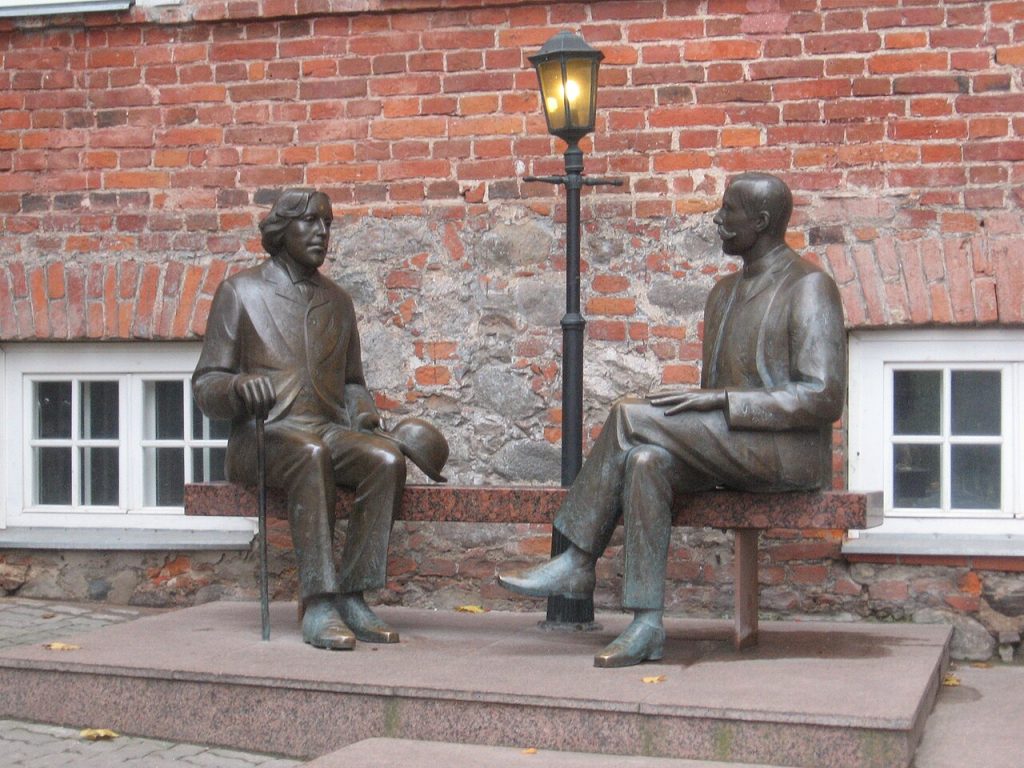
The theatre came of age. August Kitzberg’s masterpiece The Werewolf (“Libahunt”, 1911), about the rejection of an outsider in village life, fused folklore with sharp observance of both unchanging human nature and the social tensions of his day. The play premiered at the opening of the Endla Theatre, Pärnu, an event that indicated – with the opening of the Vanemuine, Tartu (1906), and the Estonia, Tallinn (1906), all with permanent professional companies – that Estonian theatre had arrived.
Many literati, including Wilde, Suits and Tuglas, fled after the Russian Revolution of 1905. fearing reprisals, and came home, immersed in Western culture, after the 1917 revolution. The times were chaotic. The period from 1917 to 1920 saw three changes of regime and a war for independence. The Siuru group, named after the fantastic bird in Kalevipoeg, was a neo-romantic product of nervous times. There was no clear aesthetic programme. Members promoted egotism and hedonism, with popular public readings. Poet Marie Under shocked conservatives with, for the first time in Estonian literature, a frank eroticism.
The Republic of Estonia (1918–1940) exploded with energy. Estland and Livland disappeared and all Estonian-speakers were now one nation. Estonian (at last!) became the official language and the language of tuition in all schools. Censorship disappeared. Johannes Aavik, helped by the Finns, pioneered a new, euphonic Estonian. Publishing boomed, and the literary scene was kaleidoscopic. Futurist poets declared “Down with lyrical chocolate!” (1920) and wrote poetry to the rhythm of city traffic on beer bottle labels. Tarapita (1921) took their name from “Taara on meiega” (“Taara is with us!”) – an Estonian battle-cry of the medieval crusades. The writers – Tuglas, Under, Johannes Semper, Barbarus, Henrik Visnapuu, August Gailit, Artur Adson – left their Siuru past behind and attacked the nouveau riche and war profiteering in confrontational expressionistic style. Younger prose writers turned to realism. Albert Kivikas’s novels about War of Independence veterans farming land expropriated from the Baltic Germans were popular. Professional organizations developed. The Writers Union (Eesti Kirjanike Liit), founded 1922, aimed to support its members and broaden discussion of cultural matters in its journal Creation (Looming). Attendance at a growing network of theatres rose. Satirical comedies about rural life by Hugo Raudsepp (1883–1952) sold out. Kultuurkapital, the state cultural endowment fund, was established in 1925 to support writers because, unlike in big countries where print runs were large, writing literature was seldom financially rewarding. Folk poetry was 100% funded. Literary prizes also stimulated output. August Jakobson won a prestigious prize for The District of Poor Sinners (“Vaestepatuste alev”, 1927), a stark depiction of a poor area of Tallinn. The novel started a trend of “slum realism” written by the populist Close-to-Life (Elulähedus) group.


The author (still) considered by many to be the greatest Estonian novelist did not approve of subsidies or prizes. Truth and Justice (“Tõde ja õigus”, published in five volumes, 1926–32) is written in a self-conscious “literary” Estonian by Anton Hansen Tammsaare and is a study of austere, self-sufficient people cultivating harsh landscapes, rural and urban, material and psychological. Tammsaare designated Karl Ristikivi, author of the “Tallinn trilogy” (1938–1942), tracing the evolution of the Estonian people from rural labourers to middle-class urban intellectuals, as his heir. It was not to be. Ristikivi fled Estonia in 1944: he never wrote explicitly about Estonia again.
The “Time of Silence,” a period of home-grown authoritarianism, began in 1934. Censorship returned. Positivism and a heroic depiction of Estonian history were now de rigueur for Kultuurkapital “state salaries”. By contrast, a wave of psychological novels about troubled relationships appeared, exemplified by Tammsaare’s Life and Love (“Elu ja armastus”, 1934) and Jealousy (“Armukadedus”, 1934) by Johannes Semper (1892–1970). The collection of the Arbujad poets, roughly translatable as “magicians of the word”, appeared in 1938: it reasserted symbolism in works that were refined, ethical and sceptical, and made poetry popular again. In 1939 Estonian literature was, said scholar, critic and translator Ants Oras, “a very living thing, eagerly read, widely and fervently discussed… worthy of prominence on the literary map of the western world.”
Everything changed after World War II. Roughly 10% of the population, fearful of a repetition of the Soviet purges of 1940–1, fled Estonia when the USSR returned in 1944. Estonia became the Estonian Soviet Socialist Republic (ESSR). Arrests and deportations followed. The “nationalist bourgeois” culture of the Republic was condemned and replaced by Socialist Realism – national in form, socialist in content. The artist was to be representational, optimistic and heroic; experimentation was deemed degenerate, censorship was strict. The Arbujad poets were labelled “decadent” and silenced. Their leader, Heiti Talvik, died in Siberia.
Early Soviet publications were unalleviated propaganda. The Writers Union was nationalised. Only works by Communist Party members were published between 1944 and 1955. The themes were the Great Patriotic War (World War II), building socialism, the revolutionary struggle, and the glorification of Stalin. The most successful writer was Hans Leberecht; his The Light in Koordi Village (“Valgus Koordis”, 1948) a novel about swamp drainage, became compulsory school reading. Drama revived despite bombed theatres, but ideology stifled vivacity. The publication of poetry books dropped from 29 in 1945–50 to ten in 1951–55.
When Stalin died, the Khrushchev “thaw” (1953–64) began. Political prisoners were released. Censorship was eased. The ESSR became the “Soviet abroad” – a display window. A new literary “plain Estonian” realism developed: the work of Juhan Smuul, set in a collective, was typical. In 1957 the Writer’s Union began publishing world literature – the “Creation Library” (Looming Raamatukogu) in cheap paperbacks. The works of Arthur Miller, Jean Anouilh, Friedrich Dürrenmatt, and Berthold Brecht entered the theatre repertoire. Poetry began to recover. Selected work by exiled poet Marie Under appeared in 1958. The 1959 poem “Simple Things” (“Lihtsad asjad”) by Debora Vaarandi marked a turning from the heroic to the personal and humane. Kafka’s expressionistic The Trial (1925) and Camus’ existential The Stranger (1942) appeared in the Creation Library in 1966 and Beckett’s absurdist Happy Days (1961) in 1969. The Last Relic (“Viimne reliikvia”, 1969), a film awash with anti-Soviet innuendo made in Tallinn, topped the box office all over the Communist bloc. Quotations by Arvo Valton and Paul-Eerik Rummo passed into the oral tradition.
The “cassette generation” (so called because their poetry booklets appeared in small cardboard boxes) emerged during the 1960s. Modernist poets Jaan Kaplinski, Paul-Eerik Rummo, and Viivi Luik rebelled against anti-intellectual “plain Estonian,” although Hando Runnel wrote in a direct style. Twenty new official poetry collections appeared in 1966, and more circulated as samizdat. That year also saw the return of poetess Betti Alver, “a warrior who guarded truth and the spirit of the nation” (according to Viivi Luik). “Star Bright Hour” (“Tähetund”), Alver’s first collection permitted to be published in 20 years, sold out immediately. Mati Unt’s novel Goodbye Ginger Cat (“Hüvasti, kollane kass”), written while still a schoolboy appeared in Creation in 1963. Caspar, the introspective, alienated anti-hero is bored by political slogans and interested in jazz, existentialism and his own adolescent issues: by saying “goodbye” to a real cat, Unt was saying goodbye to a metaphorical cat – philistinism.
Hope of more freedom faded after Khrushchev’s fall in 1964. Disillusion deepened with the quashing of the Prague Spring (1968). Reality was questioned. Mati Unt and Arvo Valton led expressions of the general malaise using symbolism, myth, Jungian psychology, and existentialism. The use of symbolism was not merely aesthetic – censorship deepened. Ionesco’s absurdist play Rhinoceros (1959) was published in the “Creation Library” in 1967. The theatre of the absurd, a Western existential reaction to World War II, was appreciated in the ESSR, where forced positivism and endemic unhappiness made absurdity a norm. Rummo’s The Cinderella Game (“Tuhkatriinumäng”, 1968), a homegrown absurdist treatment of the fairy tale was staged in Tartu in 1969.
The 1970s were a time of stagnation. Estonians tuned in to banned Finnish TV, as they were able to understand 60–70% of the broadcasts. Radio Caroline was popular. Protest was expressed in “almanacs” produced illicitly on typewriters and duplicating machines and circulated hand-to-hand. The “almanac” movement started in the 1950s and went fully underground in the 1960s. Jaan Isotamm (Johnny B), back home from deportation for protesting the suppression of the Hungarian Revolution (1956), wrote almost exclusively in samizdat. The movement peaked in the 1970s with around fifteen titles such as HEES (Hullemini Enam Ei Saa – “It Can’t Get Any Worse”). Poetry and essays dominated. Scholar Kersti Unt divides samizdat publications into idealists who related to ancient Estonian culture, Beat and hippie writers, and absurdist writers. Cabaret artist “Jüri Üdi” (Juhan Viiding) was popular 1968–1978 with performances characterised by changing roles and moods, wordplay and humour. Two significant women poets debuted officially in 1978: Doris Kareva, with introverted, confessional lyric poetry in Snapshots (“Päevapildid”); and Ene Mihkelson, concerned with the rebirth of a free society in This Winter’s
Sentences, (“Selle talve laused”).

Realism had dominated prose in the 1960s with unpretentious works about workers’ lives by, for example, Raimond Kaugver. There was now a shift, led by Jaan Kross, to historical allegory, a depiction of conflict with authority and convoluted prose. Chronological narrative, adventure and social criticism permeate Kross’s Between the Three Plagues (“Kolme katku vahel”, 1970–1980), a fictional biography of the 16th-century Tallinn chronicler Balthasar Russow whose clashes with the city council presented a thinly veiled mirror to contemporary life. Kross repeated his formula of historical allegory narrated by a sceptical Estonian, notably in The Czar’s Madman (“Keisri hull”, 1978).
Subjects examined underground surfaced with the glasnost (openness) of the 1980s. A need to remember, testify, and examine manifested itself. Viivi Luik’s semi-autobiographical novel The Seventh Spring of Peace (“Seitsmes rahukevad”, 1985) is narrated by a small girl in rural Estonia in 1950 and 1951, seven years after the end of World War II. The book is a panorama of ESSR culture, with children’s poetry and songs, a World War II marching song, a pop song by the Urb Brothers (Tarmo Urb was incarcerated in a psychiatric hospital from 1982 to 1987), and poetry by Koidula, Ristikivi and Juhan Viiding. Novels about deportation appeared. Arvo Valton’s semi-autobiographical Depression and Hope (“Masendus ja lootus”, 1989) painted an uncompromising picture of exile in Siberia. The play The Colour of Clouds (“Pilvede värvid”, 1983) by Jaan Kruusvall, portraying the difficult choices faced by an Estonian family after the Soviet occupation of 1944 is considered a watershed in Estonian theatres and set a trend that rejuvenated a popular but stultified theatre. Many young writers, however, turned away from the mainstream. Punk poetry (1986–1989), most notably by Merca (Merle Jääger) was inspired by western pop music and fashion; it was earthy, laced with colloquialisms and foreign words, and expressed protest and patriotism in direct, forceful terms.
The last days of the ESSR and the “Singing Revolution” of 1987–1991 (so called because mass singing played a central role in the regaining of independence) produced responses to changing times. In 1988, the group Wellesto, which included both “home” and diaspora Estonians, reasserted humanism and the artist’s responsibility to preserve language and culture. “The Mill Ghost”
(“Veskitont”, 1989), a story by Maimu Berg is seen as a seminal work addressing women’s issues. The essay “Art for Art’s Sake” (“Kunst kunsti pärast”, 1988) and Poems 1987–1991 (“Luuletused, 1987–1991”) by Hasso Krull heralded postmodernism. Postmodernist irreverence toward “literature” was voiced most loudly in the iconoclastic “Manifesto of Congealed Blood” (“Hüübinud vere manifest”, published in Vagabund, 1990) written by Sven Kivisildnik (a.k.a. (:)kivisildnik) and signed by a collective of young writers. The “Manifesto” embraced radical change, rejected old guard norms, Wellesto’s “civilised Europeanism” and “art,” high and low, saying “our intellectual state is feeble; we can’t find words. Therefore, what we write cannot be literature.”
Postmodernism is now just one of a range of genres and styles. The bestselling author in today’s diverse, censor-free Estonia is Andrus Kivirähk. His best-known novel, Rehepapp, (2000) is set in a village. The cast is an honours list of folk literature – Rehepapp the old barn keeper, bailiff Hans and his snow devil, Minna the witch and cats, Vanapagan (Satan), the Plague, the Landlord. Kivirähk’s success clearly demonstrates that in a modern, thriving Estonian literature filled with diversity, the oral tradition still enjoys affection and pride of place.

Hilary Bird was adopted and grew up in the UK. After a long career in public service a search for her roots led to Estonia where she found family and friends and fell in love with Tartu. She relocated from London to Tartu in 2002, and from there on reinvented herself as a scholar, writer and translator. The publication of her An Introduction to Estonian Literature is a world first in English.
© Deep Baltic 2026. All rights reserved.
Like what Deep Baltic does? Please consider making a monthly donation – help support our writers and in-depth coverage of Estonia, Latvia and Lithuania. Find out more at our Patreon page.