
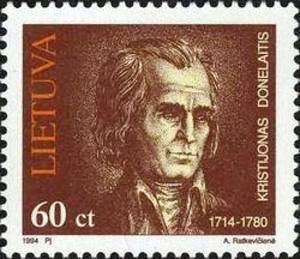
When we think of Lithuanian literature, naturally enough our thoughts turn to literature written in the Lithuanian language; and that literature conventionally begins with the writing of Metai (“The Seasons”) by Kristijonas Donelaitis in the 1760s. Metai is so famous that it can be easy to overlook the second most extraordinary fact about it – other than the fact that Donelaitis turned Lithuanian into a literary language in the first place, that is. That second most extraordinary fact is that Metai is written in the metre of ancient epic poetry, dactylic hexameters. It is a feat that no other Lithuanian author has succeeded in since, and I still remember the moment when the first Lithuanian I ever met introduced me to this piece of information. It was, perhaps, the moment that my interest in Lithuania was set on course to be more than mere idle curiosity about another interesting country. I was at the time studying for my A-Levels, and my favourite subject was Latin. I knew all about dactylic hexameters, and it had never even crossed my mind that it might be possible to write them in a living language. Suddenly, the Lithuanian language became an object of obsession for me.
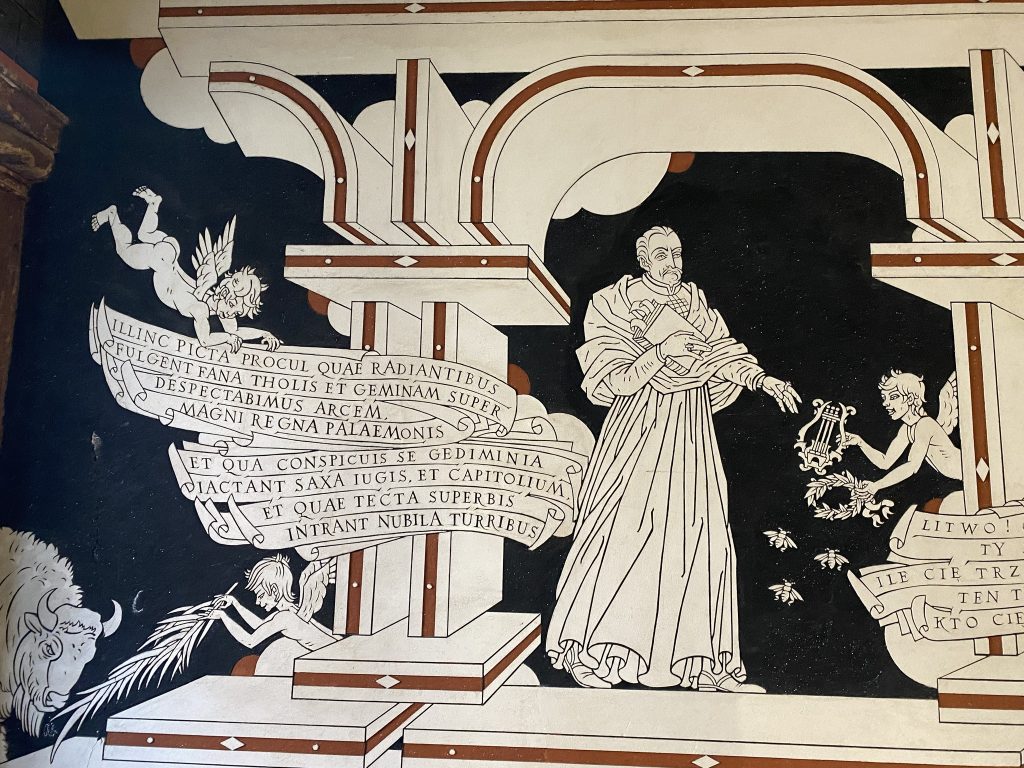
The question I did not ask back then, which is in a sense the question that this talk seeks to answer, is why the first significant work of literature in the Lithuanian language was written in dactylic hexameters. After all, Metai is not an epic in its subject matter; it is a pastorale, albeit an austere one. The reason, simply stated, is that Metai was not the beginning of Lithuanian literature, even if it was the beginning of literature in the Lithuanian language. What I mean by this is that Lithuania had a literary tradition before Lithuanian came to be used as a literary language, and that literature was written not in Lithuanian, but in Latin. The Latin literature of the Grand Duchy of Lithuania – and, in particular, its tradition of Latin epic poetry – is the subject of my most recent book, Poetry and Nation-Building in the Grand Duchy of Lithuania, which was published earlier this year by Arc Humanities Press and features translations of three epic poems by Joannes Vislicensis, Franciszek Gradowski and James Bennett.
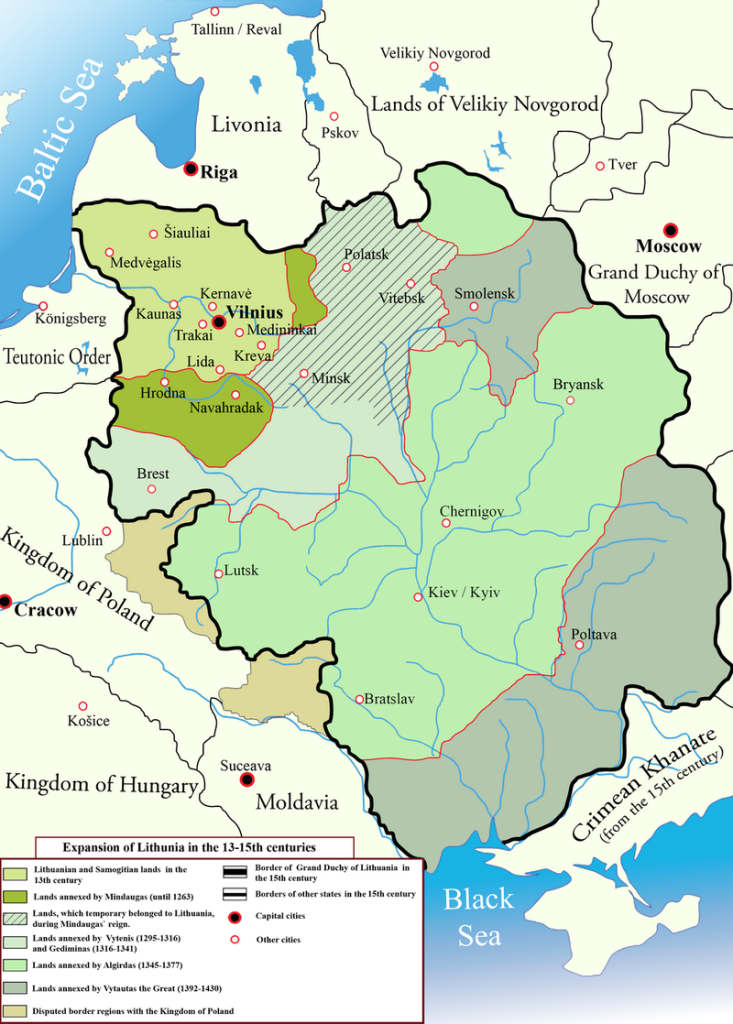
But how did this epic tradition come about, and how did Latin come to be the most important literary language of the Grand Duchy? It seems somewhat counterintuitive, since anyone who knows anything about the history of the Grand Duchy is aware that the most commonly spoken language within its borders was Belarusian (or Ruthenian), while the shared language of the nobility by the end of the 16th century at the latest was Polish. The choice of a language for literature, however, is not quite the same matter as the choice of a lingua franca for the population at large; in its literature, a country seeks to project its identity in an idealised as well as a pragmatic way. Ruthenian might have been the most widely spoken language in the Grand Duchy, but the Lithuanian elite repudiated the association with the Orthodox and East Slavic world that the use of Ruthenian implied; and by the time of the Union of Lublin the chancery of the Grand Dukes had largely switched over to the use of Latin, signalling Lithuania’s decisive political alignment with western Christendom. But the Lithuanian elite were also very clear that, in spite of their adoption of the Polish language, they were not Polish but Lithuanian. The problem was that the Lithuanian language had no written tradition before 1547, and even after the publication of a handful of Lithuanian-language books the language remained associated with the as yet unchristianised Lithuanian peasantry and lacked the prestige considered suitable for a national language.
It was at this point that historians came to the aid of the Lithuanians’ search for a national literary language, arguing that the Lithuanian language was, in fact, a form of Latin. In the 15th century a story first appears that the Lithuanians were descended from a group of Roman soldiers who were blown off course after leaving Britain in 55 BC, along with their British captives, and landed on the Baltic coast where both Romans and Britons intermarried with Goths who were then living there. Lithuanian, on this theory, was a debased form of Latin that had been influenced by the British and Gothic languages – and this was why some words in Lithuanian sometimes resembled their Latin cognates so strikingly. We know now, of course, the true reason for this – that both Lithuanian and Latin are Indo-European languages – but to 16th-century Lithuanians it was convincing evidence of their Roman descent. Latin, then, was not only a language that aligned Lithuania with western Christendom: it was also, in their imaginations, the classical form of the Lithuanian language itself. Latin thus acted as a kind of cultural placeholder for the Lithuanian language; until such time as Lithuanian became a literary language, Latin stood in for it.
The Lithuanian myth about the Roman origins of Lithuanian is important, because it meant that Latin in Lithuania was not a classicising affectation and a way for scholars to show off their learning, as it was for English authors like John Milton. Instead, using Latin was a way for Lithuanians to celebrate their Lithuanianness – a special kind of mock-Roman Lithuanianness that I call in the book Lituanitas. Lituanitas was political as well as cultural; just as the Sarmatian fantasy allowed Poles to imagine themselves as heroes of some ancient people, so Lituanitas allowed the Lithuanian nobility to imagine themselves as patrician Romans, and fed into the idea that the Grand Duchy was a res publica – a patrician republic with an elected princeps who ruled by the consent of the nobility, as indeed it was. Lithuania’s multi-religious patrician republic became the antithesis of Muscovy’s Orthodox autocracy, and helped define Lithuania’s identity against its political and cultural adversary.
So how did the Lithuanian epic tradition begin? To answer this question we need to move beyond Lithuania to Kraków, whose university began educating the Lithuanian nobility from the early sixteenth century. One man in Kraków in these years was Joannes Vislicensis, who probably came from Vislica in Poland although an attempt has been made to argue he might have been from Belarus (which was then in the Grand Duchy, of course). Either way, Joannes is significant for the development of the epic tradition because in 1516 he wrote the first epic poem in praise of the Jagiellonian dynasty, called The Prussian War. The inspiration for The Prussian War was Sigismund I’s victory over Muscovy at the Battle of Orsha in 1514, but the poem was not about Orsha. Instead, in the same way that Virgil wrote the Aeneid in praise of Augustus by writing about his famous ancestor Aeneas, so Joannes Vislicensis wrote an epic about Sigismund’s famous ancestor Jogaila. After an opening book about the legendary foundation of the city of Kraków, the poem’s second book provides a mythologised account of the Battle of Grunwald, which requires the poet to speak of Jogaila and Vytautas’s Lithuanian origins – the first description of Lithuania in any poem. Then in the final book of the poem the gods discuss providing Jogaila with a new wife, who turns out to be Sigismund’s own ancestor Sophia of Halshany. The Prussian War cannot be said to be a work of Lithuanian literature, but it emerged from the need for a cohesive narrative for the Jagiellonian realm in which both Poles and Lithuanians came to terms with the Lithuanian origins of the ruling dynasty. Joannes Vislicensis’s “Jagiellonian epic” stands at the head of both the Polish and Lithuanian Latin literary traditions, but its initial impact in the Grand Duchy was to provoke a poetic reaction from the Belarusian poet Nicolaus Hussovianus. Writing in the 1520s, Hussovianus rejected Joannes Vislicensis’s penchant for merging Christian and pagan imagery in epic, and advocated a wholly Christianised approach. His most famous poem, Song of the Bison, is an elaborate description of a Grand Ducal bison hunt that also introduces the landscape and fauna of the Grand Duchy, while other poems, such as his life of St Hyacinth, dwelt on the heroes of Lithuanian Christianity.
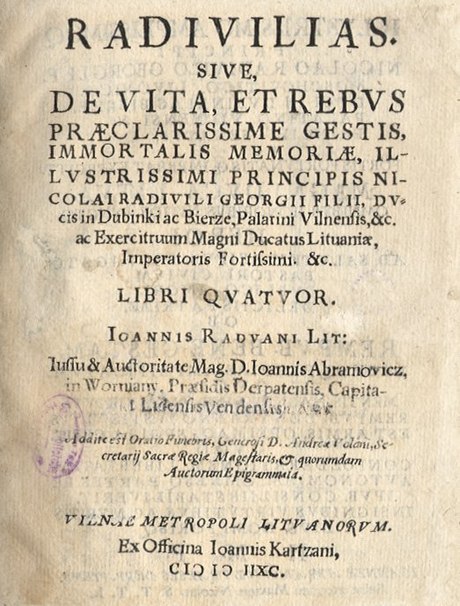
When Hussovianus died in 1533 he had no obvious literary successor, and epic poetry lay fallow in the Grand Duchy until the Livonian War. The siege of Pskov in 1580 and the exploits of the Radziwiłł family – and, more to the point, the Radziwiłłs’ wealth and patronage – produced a new flowering of epic poetry that was ever more self-consciously Lithuanian. As Grand Chancellors and Grand Hetmen of Lithuania, the Radziwiłłs enjoyed a degree of autonomy as Lithuania’s subordinate rulers, and defended the distinctiveness of Lithuanian identity and freedom of religion (they were Calvinist Protestants) against polonising tendencies (even if the Radziwiłłs were culturally polonised themselves). The promotion of Latin literature was one way to do this, and it was under Radziwiłł patronage that the best known of all Lithuanian Latin epics, Radivilias by Jan Radwan, was written in 1588.
Radivilias is ostensibly about the exploits of Mikołaj Radziwiłł ‘the Red’ (1515–84), but provides an overview of various episodes in Lithuanian history and traces the ancestry of the Radziwiłłs themselves to Lizdeika, the pagan priest who interpreted Gediminas’s famous vision of the iron wolf. Radwan’s Radivilias, however, was just one of the epics about the Radziwiłł family produced at this time – a shorter epic by the Kaunas-born poet Franciszek Gradowski, “The Muscovite Expedition”, was published in 1581 and is about Krzysztof Radziwiłł’s daring raid deep into Muscovy during the siege of Pskov. Early in the 17th century, Lithuania’s wars against Sweden became the subject of another epic, the Carolomachia (which famously recorded a Lithuanian battle-cry, the first Lithuanian word to feature in an epic poem), but the Deluge of the mid-17th century devastated centres of learning such as Vilnius University, as well as the publishing industry. It is all the more remarkable, therefore, that an epic poem was published at Vilnius in 1674. This was The Strength of the Lord’s Right Arm by James Bennett, a poem of particular interest to me since Bennett was of British descent. He was still a teenager when the poem was published, and it is possible it was effectively written for him by one of his professors. Bennett was the son of George Bennett, a Scottish emigré who served as one of the Lithuanian commanders at the Battle of Khotyn in 1673. This was a crucial battle in which Lithuania rebelled against the Ottoman Empire, which had forced a weakened Grand Duchy to pay tribute as a de facto fiefdom of the Sultan. It saw Jan Sobieski rise to prominence as leader of the Polish forces, but Bennett’s focus was on Lithuanian defiance and the leadership of the Pac and Sapieha families.
James Bennett’s Strength of the Lord’s Right Arm was, strictly speaking, the last Lithuanian Latin epic. It was not, however, the last Latin poem of epic length written in the Grand Duchy, and in the eighteenth century there were several lengthy encomiums on military heroes killed in battle. Indeed, a long Latin poem was even composed to celebrate the coronation of the last King of Poland and Grand Duke of Lithuania, Stanisław August Poniatowski, in 1764. By the late 18th century, however, the vernacular was overtaking Latin as the main vehicle of literary expression; the Romantic movement privileged national vernaculars as expressions of the soul of the nation, consigning earlier Latin literature to oblivion as an archaic affectation. Yet both in Donelaitis’s Metai and Adam Mickiewicz’s Pan Tadeusz, the commitment to the vernacular was balanced by a continued loyalty to the epic form – a lasting legacy of the now largely forgotten Latin epic poets of the Grand Duchy of Lithuania.
The aim of my book Poetry and Nation-Building in the Grand Duchy of Lithuania is to introduce some samples of this largely unknown literature to the English-speaking world, by providing translations of three works that represent the beginnings, middle period, and end of the Latin epic tradition. These poems have previously been translated into Polish, Lithuanian and Belarusian but have hitherto been inaccessible to an English-speaking audience. It is my hope that these translations might stimulate further work on this fascinating poetic tradition, which has a great deal to tell us about the early formation of Lithuanian national identity. Lithuania makes for an interesting contrast in this regard to Latvia and Estonia, whose national epics date from the 19th century – Lithuania’s epic tradition is three and a half centuries older than that of its Baltic neighbours. At the same time, however, the literary tradition of the Grand Duchy of Lithuania will always occupy a somewhat problematic position in modern Lithuania, not only because it is in the Latin language but also because it is as much Belarusian as Lithuanian, and often reflects polonised assumptions. Nevertheless, I make the case in the book that the writing of Latin epic was a distinctively Lithuanian activity.
This is the text of a talk delivered by Francis Young to the British-Lithuanian Society on 10 September 2024
Francis Young is a historian of religion with a particular interest in pre-Christian Baltic religions. He is the editor of Pagans in the Early Modern Baltic (2022) and teaches at Oxford University’s Department for Continuing Education.
© Deep Baltic 2025. All rights reserved.
Like what Deep Baltic does? Please consider making a monthly donation – help support our writers and in-depth coverage of Estonia, Latvia and Lithuania. Find out more at our Patreon page
