
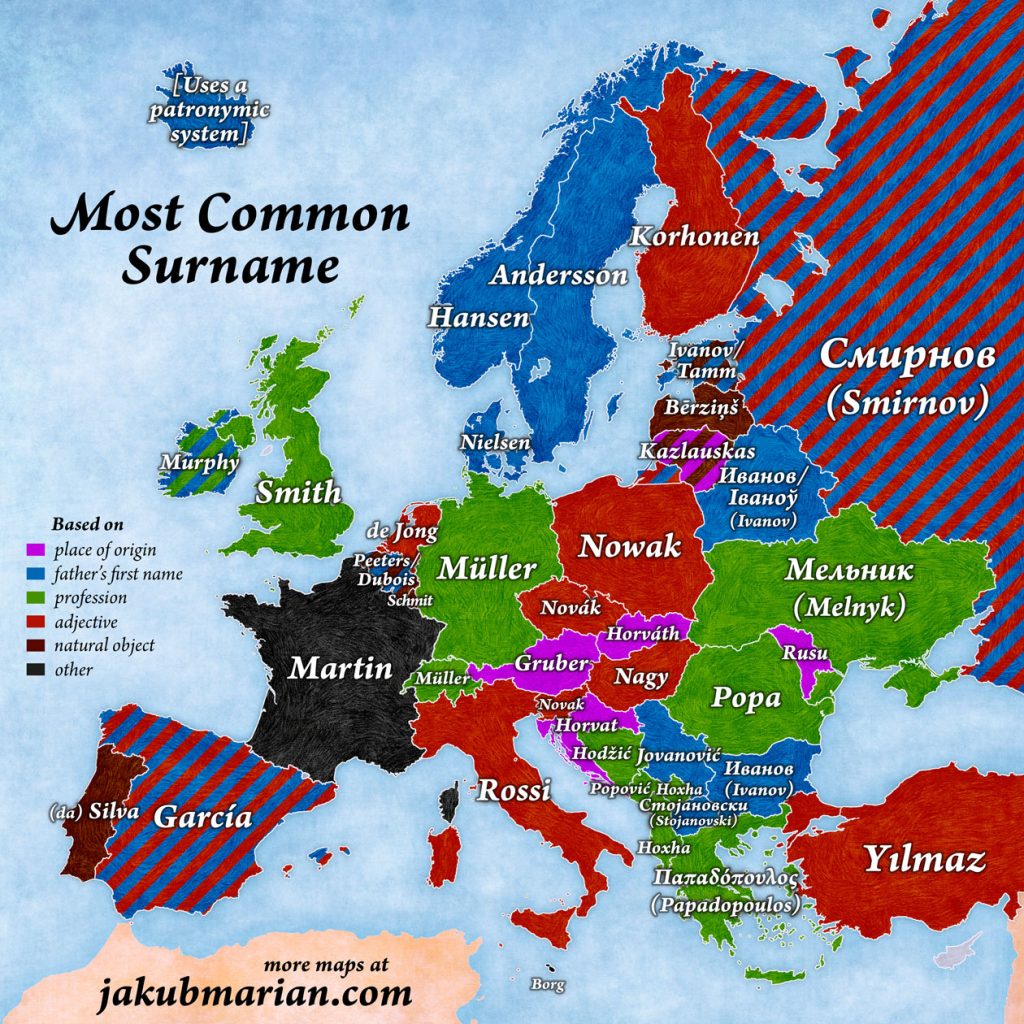
Surnames are something that all of us in Europe have (now), but there’s a huge amount of variation both in the date of adoption and the forms they take across the continent. Surnames in the sense they are understood nowadays arrived in England with the Norman Conquest after 1066; prior to that, many of the Anglo-Saxon and Celtic inhabitants of the country had nicknames that were used for identification in case of ambiguity, but these were not passed onto future generations. Iceland uses a different system from the rest of the continent, with most people’s surnames deriving from their father’s first name, with “son” or “daughter” (dóttir) added afterwards. Greek surnames often reveal the region of the country that their bearers’ ancestors originated from. Hungary, uniquely in Europe, places family names before given names, while in Lithuania, women’s surnames usually indicate their married status.
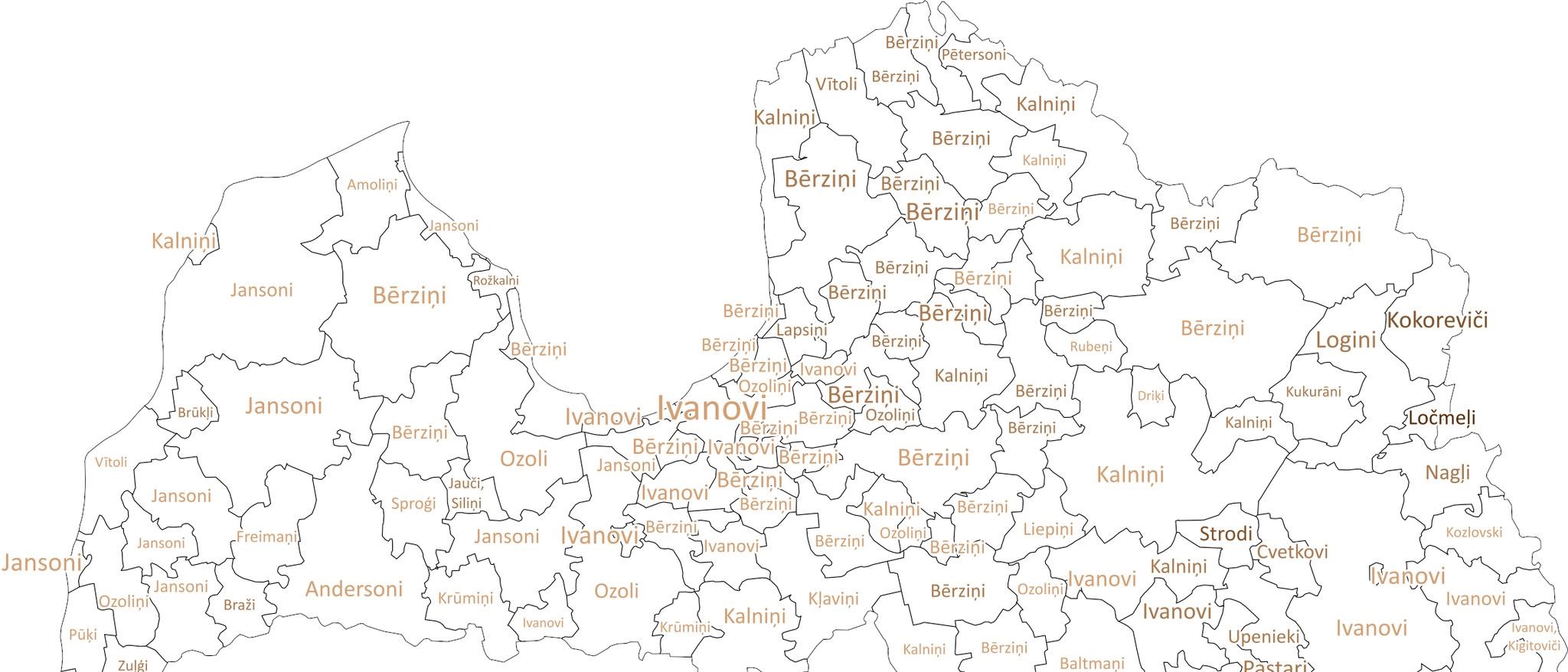
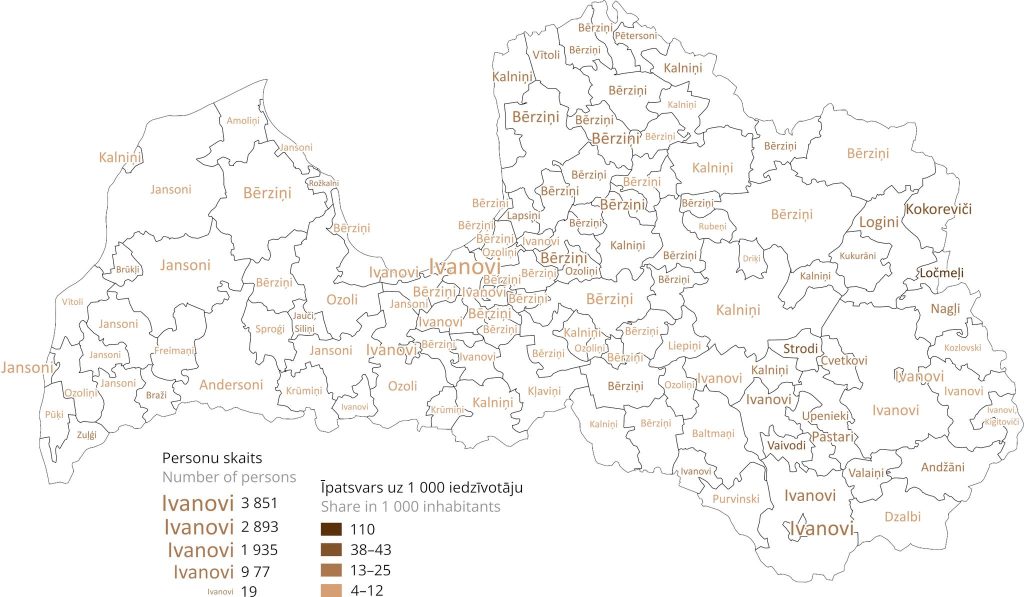
In Latvia, although most surnames change depending on whether the bearer is male or female, this level of distinction is not made. Many common surnames clearly display the influence of the many countries and cultures that have controlled the region (most influentially across the majority of Latvia, the Baltic Germans, the richest and most dominant section of society between the 13th century and World War II). Official figures show that the most common surname in the country is now Ivanovs, although this is likely to be largely a consequence of the extensive migration of Russians and other Eastern Slav ethnicities into Latvia after its occupation by the Soviet Union in 1940. The other surnames borne by over 5,000 people in the country of around two million are (in the masculine form) Bērziņš, Kalniņš, Ozoliņš, Jansons, Ozols, Liepiņš, Krūmiņš and Vasiļjevs. Ilmārs Mežs has published extensively on Latvia’s demography, compiling a three-volume compendium of Latvian surnames by region – Deep Baltic’s Will Mawhood spoke to him about what the nation’s family names can tell us about the country’s historical experience, and how the situation in Latvia differs from other parts of Europe.
I believe that most Latvians were given surnames in the sense we now understand them in the 19th century. Did people in Latvia before that have anything that could be compared to a surname, or simply go by their “first” name?
The majority of farmers in Vidzeme and Kurzeme chose surnames in the 1820s or 1830s; however, in Latgale farmers had surnames significantly earlier. The 1599 [Polish] census shows many surnames in villages in Latgale, and the same ones can still be found there right up to the present day. In Vidzeme and Kurzeme too, older documents show surnames or their predecessors, but under serfdom surname usage was interrupted for many. Instead, names connected with places of residence were used more often – so if Jānis lived in a dwelling called Kalniņi, he would be Kalniņu Jānis, and if he moved to somewhere called Lejiņi, he would be Lejiņu Jānis. As long as this was happening in small, closed communities – for example, in the vicinity of manor houses – it was clear to everyone which Jānis was being talked about, but as time went on misunderstandings started to occur and surnames were brought in. There were also some other places in Europe – for example, in Finland, Denmark and Sweden – where surnames were introduced relatively late.
You discuss, in the programme Zināmais nezināmajā, why it would not be uncommon for a Latvian family over the course of a few generations to have had the surname Kalniņš, before changing it to Bergs, and then reverting to Kalniņš [both names mean “hill”, but the first/last is in Latvian, while the middle one is in German, with a small adjustment made for Latvian case endings]. What would be the explanation for this repeated change?
Those surnames taken in the 19th century had not completely taken root, and sometimes they were “translated” into German, and in Latgale occasionally into Russian. First names were changed in a similar way – so Jānis might be Johann in documents written in German, or Ivan, if they were in Russian. Then, after Latvia won its independence, people sometimes wanted to reclaim their original surnames in Latvian, and these germanised surnames were changed back to their initial historical form. But a large majority of Latvians with German surnames did not change them, and today there remain many people with the surnames Grīnbergs, Freimanis, Kaupmanis, Fišers, Freibergs, Rozenbergs, etc. More rarely, you get surnames where the start is in Latvian and the end is in German, like Vītolbergs [vītols is Latvian for “willow”].
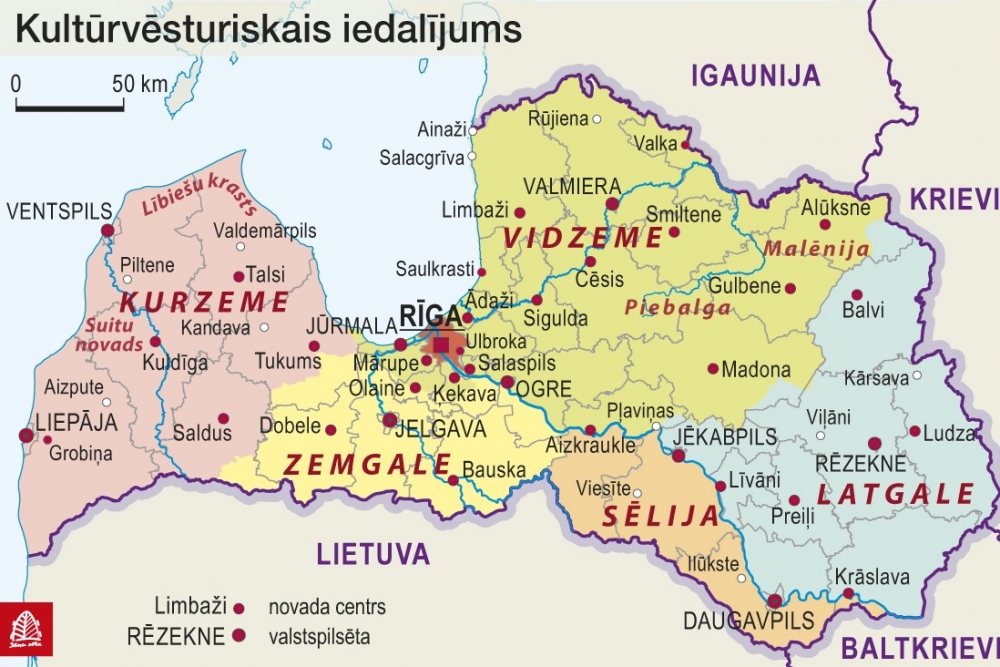
As you describe in that programme, names of German origin dominated and continued to dominate especially in a band from north-central Kurzeme as far as Jelgava. In other parts of Latvia – for example, in Vidzeme, Latvian names are more common. Is there a reason for this?
Surnames derived from German were very common and even dominated in Kurzeme (with the exception of the Suiti area and Lower Kurzeme), as well as in central Zemgale and in Vidzeme close to Riga. A large number of them have survived to the present day.
By contrast, surnames derived from Latvian were chosen more often among the Suiti, in Lower Kurzeme, Sēlija, Piebalga, Maliena and in the central and eastern part of Vidzeme. Evidently at that time Latvian farmers wanted to take more refined-sounding names, and in the aforementioned regions it was more often the style to choose German names. Maybe how wealthy people were also had an impact: among the less wealthy names derived from Latvian were more common, while the better-off more often wanted to emulate the gentlefolk – that is, Germans. That may seem strange from a modern point of view, but if we go to a kindergarten and take a look at the kinds of names that Latvians are giving their children at the moment, frequently they will be influenced by the current fashion for the English language.
In general, in Latvia de-Germanification of names [in the interwar period] seems not to have gone so far as in Estonia (around a third of Estonians changed their names). Why was there less uptake for this in Latvia?
That would be an interesting subject to research in general – most likely until the very end of 1939, there was no concerted encouragement from the government for people to change their names. Surname-changing on a truly mass scale took place only in the first half of 1940, when each month a couple of thousand inhabitants changed their surnames. In those six months, more Latvians changed their surnames than in all of the previous 19 years put together; in total, during the first period of independence, only 1% of the population changed their name. By contrast, in Estonia the government started to encourage people to “estonianise” their name significantly earlier – and for that reason ten times more people did so than in Latvia.
It should be added that often this change meant getting rid of compound surnames, where names often had two or even three similar-sounding elements – for example, Vanags-Vonogs etc. Most often people would choose to keep only the most desirable of these multiple surnames. These names arose because during the Tsarist period, there were no standardised regulations for writing surnames – moreover, Latvian surnames were most often written in German or Russian. The first documents people received issued by the Republic of Latvia tended to list the various existing versions of the surname, but now written in Latvian [according to Latvian conventions]. Quite often there were some differences in spelling, as well as influences from regional dialects, or the surname being changed from or to the diminutive form, or due to mistakes. For example, if the clerk didn’t speak Latvian, then it was quite easy for surnames to be rendered with errors, which could remain on documents for a prolonged period. The most frequent examples were “doubled” surnames, such as “Gailis-Gailītis” and “Grigors-Gregors”, as well as “translated” surnames like “Volfs-Vilks” [combining a Latvianised version of the German word “Wolf” with a translation into Latvian]. Less frequently surnames could be found with three or more similar forms “Grundsteins-Grunsteins-Grundšteins”.
The second reason for changing a surname was returning to its meaning in Latvian.
Were there any particular trends in the “Latvian” names that people took up over the years? Are there noticeable differences between those given (or chosen) in the 19th century and in independent Latvia?
Before surnames were taken [in the 19th century], a list of recommended names was published in the press – the advice was to choose from four types of names:
- “You can take your surname from a trade, rank, employment or means of earning your living that you already have or you would like your children to have (Arājs [Ploughman], Dravnieks [Beekeeper], Dziedātājs [Singer], Jātnieks [Horseman] or Kalējs [Blacksmith])
- “From some characteristic or physical or spiritual feature, which you have yourself or would like your descendents to have (Bagāts [Rich], Biezais [Broad], Daiļais [Beautiful], Godīgs [Honest] or Melngalvis [Black-Headed].
- “From created objects, from beasts, birds, fishes or other living creatures of God, or from trees, bushes, grass or flowers, which grow from the ground, or from rocks or other things (Auns [Ram], Briedis [Deer], Balodis [Pigeon/Dove], Zvirbulis [Sparrow], Akmens [Rock]).
- “Lastly, you can also take your surname from a tool or from some thing that is well-known and useful to you (Dālders [a coin no longer in circulation], Dārziņš [Small Garden/Allotment], Kažoks [Fur Coat], Kauliņš [Dice], Kokle [traditional Latvian instrument similar to a zither])”.
By contrast, in the 20th century before World War II, as well as directly translating their surnames [into Latvian], people fairly often chose lyrical surnames such as Eglājs [Spruce Grove], Salnājs [Frost], Dzelme [The Deeps of the Sea], Krasts [Shore], Sējējs [Sower], etc.
It’s very striking, for those foreigners who are able to understand the languages, the prevalence of nature-inspired surnames in the Baltic countries, where in most other parts of Europe surnames related to professions or descriptions of appearance seem more prevalent. Perhaps the classic Latvian surname would be Bērziņš (birch tree). Was this simply the result of a mostly rural population looking around them and choosing the objects that are most familiar/nearest to hand?
Perhaps, [although] it was more that the previously mentioned guidance for giving surnames was being kept in mind. I think it’s similar with the Estonians and Finns – we rarely understand the meaning of their names, but it seems like they also have a lot of surnames connected to nature. Among the very commonest Latvian surnames natural themes dominate, but if we look at the rest of the surnames there are quite a lot connected with occupations, appearance or origin. And also many patronymic surnames, where a surname is derived from the father’s name – Jansons, Jēkabsons, Petersons. But a feature which stands out among Latvian names –and maybe in the Latvian language in general – is the great frequency of diminutives: Bērziņš (little birch tree), Kalniņš (little hill) and Ozoliņš (little oak), but rarely Bērzs, Kalns or Ozols [the same words but in the “non-diminutive” forms].
Has the fact that many families’ surname has changed – sometimes more than once – in a relatively short time period caused administrative difficulties?
Well, surnames can be changed in just about every country in the world. I can’t rule out that there may have been some rare incidents, but on the whole surname alterations proceeded speedily and according to the rules. However, for a number of families the fact that they had only just changed their surname apparently helped them avoid being deported. It was probably for that reason that, when the process started again after the war, those changing their surnames were scrutinised by the KGB, in case it happened that the change was being made with the intention of hiding their previous identity, which could have been something undesirable to the occupying power.
If choosing a German-derived name may have been a way of emphasising your status among ethnic Latvians in the majority of modern-day Latvia, in Latgale [where the aristocracy were mostly Polish-speaking] did Polish surnames have the same appeal?
Yes – in Kurzeme and Vidzeme it was seen as more refined to be a German than a Latvian, but in Latgale it was more common for people to show they were a cut above by assimilating with the Poles. This is shown by the Polish surnames found there too: for example, Kokorevičs, Mazarevičs, Stankevičs, Bukovskis and Mežeckis. On occasion there were also Russian names. From a contemporary point of view, it might seem to us that it would be better not to choose German, Polish or Russian names, but for everyone to stick to their Latvian names. Here parallels can be drawn with traditional farmers’ dress, which Latvians wore several centuries ago. And it was just around the time of surnames being taken that Latvian farmers started to abandon their traditional handmade attire and gradually started to dress “according to the fashion of the city” – some might say in a German style, although in fact it was more simply what was seen as modern at the time, and they cast off their old folk skirts, long coats and resplendent colourful belts and went over to more modern clothing. Nowadays we don’t go about every day in folk costume; we dress in – as it seems to us – traditional European clothing. It’s a similar story with surnames and first names – every generation brings something new, abandons something old, but then sometimes also finds something old that is interesting and puts it into use again.
Are there any distinct qualities otherwise about Latgalian surnames, compared with surnames elsewhere in Latvia?
The main characteristic of the surnames of Latgalian Catholics is that, in most cases, they are much older than surnames in Vidzeme and Kurzeme. If in Vidzeme and Kurzeme surnames were adopted 200 years ago, then in Latgale they were being used 300 and even 400 years ago. And for that reason the meaning of many Latgalian surnames are now forgotten. Of course, no one gives a surname that has no meaning, but over such a long period of time our language has changed and the meanings have been lost. Moreover, Latgale has several surnames forms with endings that don’t exist elsewhere in Latvia – for example, especially in the south-western part, “išs” in names like Ūdrišs and Pumpišs; or “o” in Puzo, Brežgo or Umbraško. The Latgalian surname ending found most often is “-āns” – for example, Andžāns, Antāns, Leitāns, Jurkāns, Piterāns, etc.
These kind of endings are widespread in Maliena and Sēlija, but further west this changes to “-ēns”, for example Lūsēns, Māsēns and Sauķitēns. These suffixes are the only Latvian suffixes [i.e. derived from the Latvian language] which are used to form patronymic surnames – the son of such and such a father. The son of Ants becomes Antāns. Elsewhere in Latvia there are more Jansons, Petersons and Simsons – several hundred different surnames, which are very widespread.
Latvian names are often challenging to pronounce and remember for non-Latvian speakers. Have there been cases of Latvians (abroad or even within Latvia) trying to simplify or adapt their name for this purpose?
It’s probably hard for me to judge, but I really wouldn’t say that Latvian surnames are especially difficult for foreigners – from my point of view, many Hungarian, Greek, Chinese, Sri Lankan and Indochinese surnames are long and challenging; that’s without even talking about the difficult surnames of the Arab countries, which moreover are completely different for a husband, wife and the children they’ve had together. It’s more that there can be difficulties for those small numbers of Latvians whose surnames have a crude or even offensive meaning in English or another language. The surnames Šics [pronounced “shits”] and Farts come to mind. It’s similar with the blameless Lithuanian surnames Dirsiene and Dirse, which cannot help but raise a smile among Latvians [dirst means “to shit” in Latvian].
Do people continue to change their surnames very much these days, and what are the main reasons now?
I would have to check to give a precise answer, but I believe there are around a thousand cases a year. The majority of them are recently married women, who take on their husband’s name, or create a double-barrelled name by combining the two. On rare occasions there are examples of strange names which have been preserved, and where the bearer wants to put an end to the endless sniggers and misunderstandings. If before the war in Latvia there were at least a hundred people with the surname Mulkis, nowadays none remain [this sounds very similar to muļķis, which means “fool” in Latvian]. The villages named Lielie Muļķi and Mazie Muļķi [literally, Great Fools and Little Fools] close to Krāslava were established three centuries ago, and at that time this word had a different meaning in that region.
© Deep Baltic 2026. All rights reserved.
Like what Deep Baltic does? Please consider making a monthly donation – help support our writers and in-depth coverage of Estonia, Latvia and Lithuania. Find out more at our Patreon page
