
by Brigitta Davidjants, TALLINN
Estonian Punk and J.M.K.E. as a Critique and Chronicle of Their Era
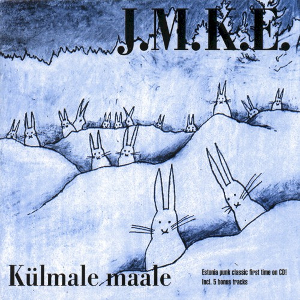
Popular music often leads us to histories that are absent from textbooks or told only in fixed and over-familiar ways. At the same time, sometimes a single song can reveal how ordinary people experienced political change, social conflict or cultural transformation. That is why I decided to write a book about To the Cold Land (“Külmale maale”, 1989, released by Stupido Records, Helsinki), the debut album by Estonia’s most legendary punk band, J.M.K.E., featuring their leader, singer and guitarist Villu Tamme; bassist Lembit Krull; and drummer Venno Vanamölder.
I discovered J.M.K.E. in 1996 as a teenager. Less than a decade earlier, Estonia had still been part of the Soviet Union. The Singing Revolution was already underway, and I, too, had stood in the Baltic Way alongside my family. The soundtrack of that period is usually remembered through patriotic songs such as Alo Mattiisen’s “Eestlane olen ja eestlaseks jään” (“I Am Estonian and Will Remain Estonian”) and “Ei ole üksi ükski maa” (“No Land Is Alone”). Yet there was also another soundtrack to the era: louder, angrier and much more ironic, provided by J.M.K.E.
No other Estonian band has maintained such a complex relationship with its historical moment. Their songs captured the dramatic social transformations of the late Soviet period while simultaneously reflecting on the past and imagining possible futures. More specifically, J.M.K.E. represents a textbook example of how punk can function simultaneously as political critique, historical testimony and collective memory. Analysing the lyrics, music, historical context and oral histories surrounding To the Cold Land, several broader cultural narratives emerge.
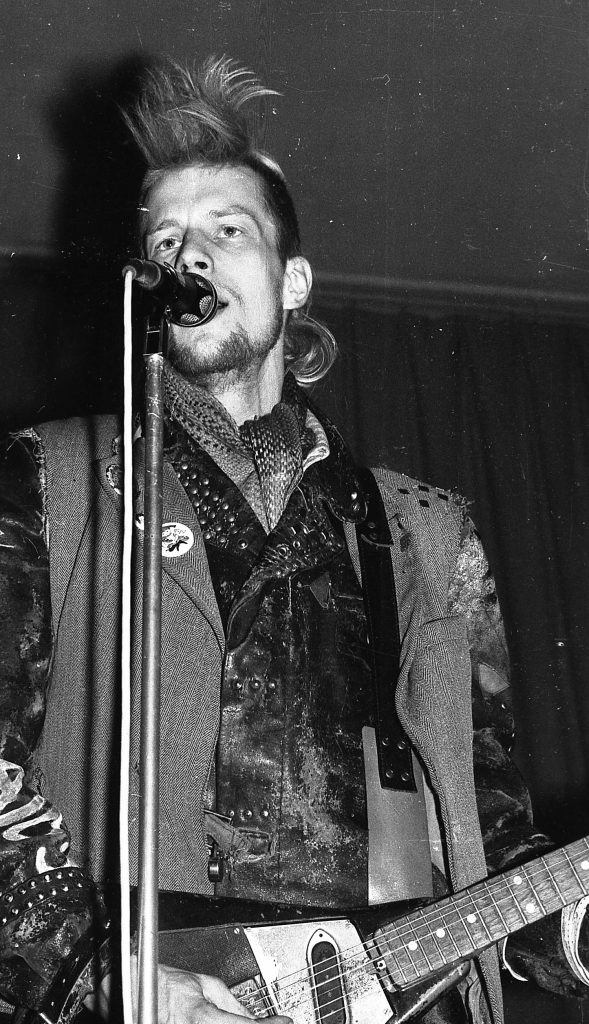
Punk Arrives in Estonia
Soviet-era Estonian punk overlapped with two distinct political phases. The first was the period of stagnation in the late 1970s and early 1980s, characterised by economic decline and intensifying Russification. It was during this grim climate that punk landed in Soviet Estonia, sparked by the performance of the Sex Pistols on Finnish TV, which could be seen – illegally – in northern Estonia. In my research on Estonian women in the early 1980s punk scene, every interviewee recalled their first encounter with the subculture. For instance, Krista (born 1964, name changed) noted:
“I was in seventh grade at the time, I think it was 1977. ABBA and Boney M were popular back then – pleasant tunes that left me relatively indifferent. And then I saw the Sex Pistols on Finnish TV. I didn’t know what it was, and I didn’t even know the word ‘punk,’ but it completely fascinated me because it was so radically different from anything we had in the Soviet Union.”
Picking up signals from beyond the Iron Curtain offered youth a glimpse into Western consumer societies, which Soviet propaganda routinely claimed were “rotting away”. This was also was the reason why, under the Soviet regime, Estonian punk was driven by an anti-communist ethos and a longing for a democratic, and even capitalist society. Although Estonian youth had no direct experience with the West, the information that filtered through the Iron Curtain caused them to idealise it.
From that point on, punk proliferated. It manifested first in urban spaces through provocative fashion, often found in attics or grandparents’ closets, and quickly evolved musically.
While it captivated the youth, it infuriated the authorities. Many early punks recall being detained by the militsiya, having their accessories confiscated, and occasionally being beaten up. During this era, subcultural defiance carried severe real-world consequences. For example, one woman I interviewed recalled being told outright by officials, “You will never get into university.”
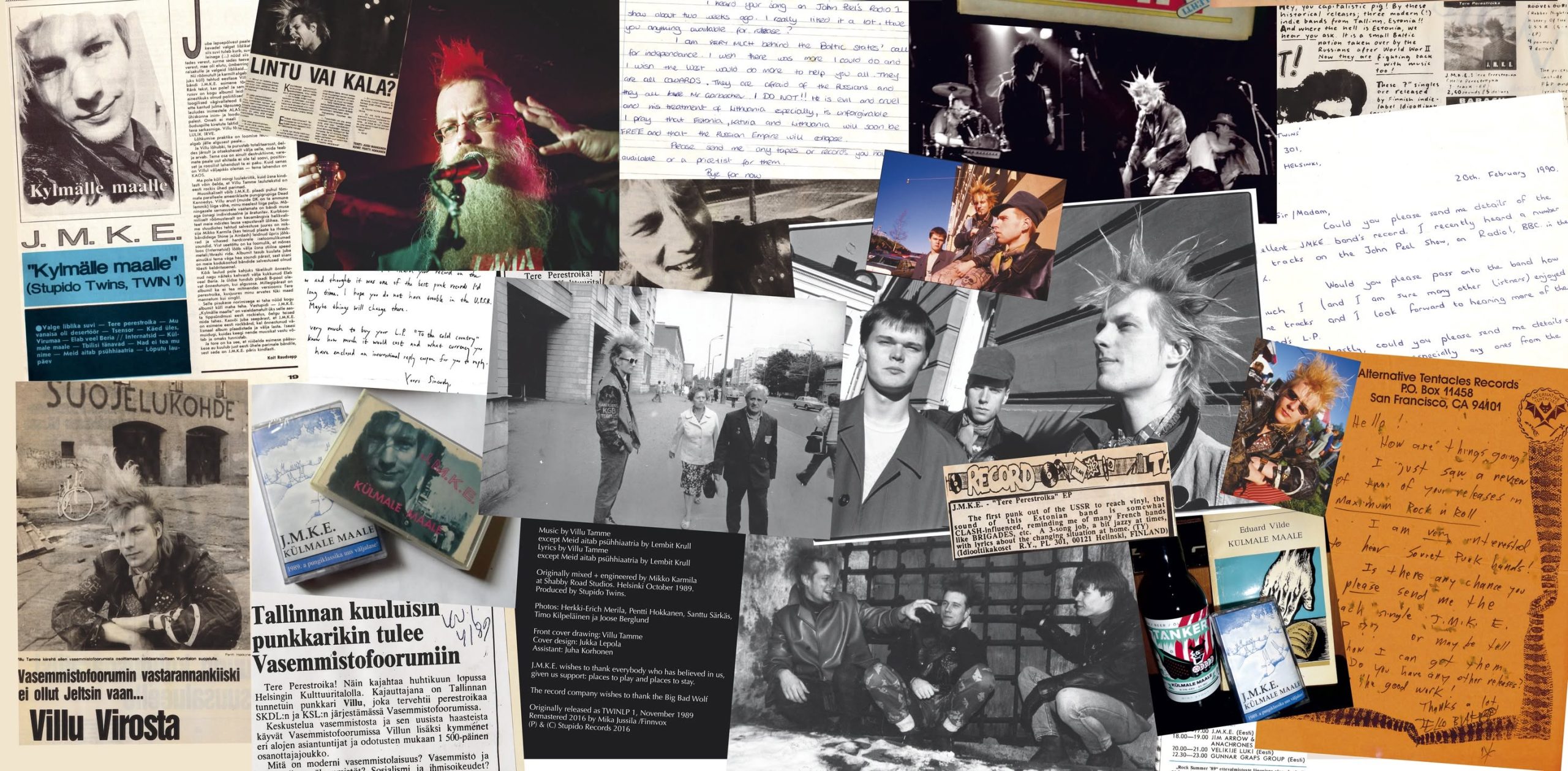
The landscape shifted in the latter half of the 1980s with the declaration of perestroika and glasnost. Paradoxically, punk became popular, even fashionable; it became a mainstream vehicle for musical resistance against the regime. J.M.K.E. were at the centre of this transition. As researcher Ott Kagovere has noted, songs like “Hello Perestroika” (“Tere perestroika”) became genuine hits because their message resonated with the entire Estonian population, not just teenagers looking to dress up, drink and rebel.
Remembering a Silenced Past
What made J.M.K.E.’s To The Cold Land so special? The album’s 12 tracks were written between 1985 and 1989 – the earliest of them just before the dawn of perestroika, and the latest just prior to Estonia’s restoration of independence. This meant that the album was released precisely when it became possible to speak openly about topics that had been forcibly silenced for almost half a century. The record captures the volatile emotions during the Soviet collapse, while looking back at Estonia’s tragedies of the 20th century, transforming the tracklisting into a poetic narrative spanning from Stalinism to perestroika. At the same time, because the musicians are reflecting on historical events that occurred before their birth, the album functions as an act of collective memory. All in all, the music and lyrics show how alternative youth saw Soviet reality and power dynamics, aligning the record with the global punk tradition.
The sonic architecture of the album is just as vital as its lyrics, interweaving perfectly with the text to reinforce its message. Frontman Villu Tamme adopts various personas across the tracks, speaking at one moment from the perspective of an ordinary Estonian, then from the position of an authority figure. There are moments when the band parodies Soviet Pioneer (communist youth organisation) songs to expose the absurdity of state propaganda, or deploys military march beats, only to subvert them with hardcore punk and surf-rock guitars, blues basslines, and erratic, shifting drum rhythms.
The tracks on the album can be divided into three thematic categories: songs addressing Stalinism, stagnation, and perestroika. The tracks about Stalinism focus on the traumatic decade between 1940 and 1950, marked by wartime mobilisation and mass repressions. For example, in “Beria Still Lives” (“Elab veel Beria”), Tamme directly condemns the bloody legacy of Stalin, referencing the KGB and concentration camps. The underlying hopelessness stems from the fact that this historical reference is not merely a reflection on the past, but an active engagement with the present. By asserting that Stalin’s secret police chief, Lavrentiy Beria, is still alive, Tamme argues that despite contemporary reforms, the totalitarian nature of the Soviet system remains unchanged.
Living Through the End of the Soviet Union
The second category reflects the immediate reality experienced by the musicians: the hopelessness and stagnation of the ’70s and ’80s. This era was defined by the personality cult of Leonid Brezhnev, aggressive censorship and systemic despair. Tamme recalled how deeply he felt the pressure of a system designed to crush youth:
“There was a kind of indifference, a sense that there was no future anyway. At the time it seemed that the Soviet Union would remain in command forever. One day they’d probably lock me up, so I couldn’t plan for the future. I saw no future. I thought about becoming an artist but couldn’t get into ERKI [the Estonian National Art Institute]. At that time, the rector lived in the lower flat in our building. We weren’t close acquaintances, but we knew each other. Then he showed me a letter in his office but, when I started to look at it, he pulled it away and wouldn’t let me read it, instead saying simply that ‘We are not allowed to let you take the exam’.”
It was no wonder that the ‘no future’ message resonated so strongly with Soviet youth. The regime had various techniques it used to control culture, including official or pop culture: having to obtain performance permission from the Culture Ministry committee, concert bans, criticism, moral and physical pressure. J.M.K.E. chronicled these institutional abuses explicitly. For example, “Censor” (“Tsensor”) exposes the mechanisms used to silence creators, while “Psychiatry Will Help Us” (“Meid aitab psühhiaatria”) attacks the sinister Soviet practice of using punitive psychiatry to confine political dissidents in asylum-prisons.
The third group consists of perestroika songs, which tracked historical shifts in real time as the Soviet Union began to fracture. When Mikhail Gorbachev introduced perestroika (literally “restructuring”), Western observers hailed these moves as signs of democracy. Many Estonians, however, viewed them with profound scepticism; state promises had too often diverged from reality. This cynicism peaks in the album’s title track, “To the Cold Land”, the angriest and boldest song on the record. The track warns that any misstep will result in Estonians being deported to Siberia once again, capturing the fear that murderous Stalinist policies were merely dormant, waiting for the right moment to return.
And then, out of this excitement and cynicism, came a singing revolution. This is the umbrella term used for the events that led to the restoration of independence for the Baltic states. During that period, patriotic songs were sung publicly, and illegal Estonian flags were brought out – for example, during the Old Town Days festival in Tallinn’s Town Hall Square, even though the militsiya tried to take them down. Alongside this mainstream pop, J.M.K.E. provided the Singing Revolution with its unofficial anthem – the song “Hello Perestroika”. Latvian researcher Guntis Šmidchens has aptly analysed the song as offering overly enthusiastic support for the new government campaign. But, as if in passing, it speaks the truth about the decades-long Soviet system: it’s a dictatorship, the red flag is a symbol of violence, the newspapers lie and punks are beaten up. At the very end of the song, Villu sings: “I’ll say hello to you as long as I get you,” hinting that perestroika is a sham. The song ends with the phrase “hello perestroika, give me your paw”; in conversational Estonian, the expression “give me your paw” is an informal, friendly invitation to shake hands. But the song’s ironic tone redefines the phrase, instead reminding us that this is a dangerous partnership. The song is also musically ambivalent. It mocks the Pioneer songs that everyone knew, full of optimist belief in a bright future. But an attentive listener with the Soviet-era ability to read between the lines would knew that this hope was being shadowed by the fear of disappointment, reflecting the feelings of many at the time.
Anarcho-Pacifist Punk
It is common to view J.M.K.E. as first and foremost an anti-Soviet band, but this interpretation is too narrow. The album’s critique extends beyond a specific regime to target the universal mechanics of institutional power and violence. As their songs are deeply pacifist, they interrogate the nature of state-sanctioned warfare, the interests protected by armed institutions, and the subjugation of the individual to systems they had no hand in creating. This global perspective firmly anchors J.M.K.E. within the international anarcho-punk tradition.
This ethos is clear for example in “My Grandfather Was a Deserter” (“Mu vanaisa oli desertöör”). While official history narratives romanticise soldiers as heroic patriots, J.M.K.E. placed moral virtue on the act of desertion. The song subverts traditional notions of bravery by suggesting that refusing to participate in state warfare can be the highest ethical choice an individual can make. A similar sentiment defined “They Don’t Know My Name” (“Nad ei tea mu nime”), which – in the context of the war in Afganistan – depicted the individual’s struggle against an anonymous bureaucratic war machine designed to strip away human identity. Songs opposing nuclear war, such as “Summer of the White Butterfly”, are equally important. Unlike many other musicians, however, Tamme does not simply paint a terrifying post-apocalyptic picture; he speaks through symbols, as if with a detached smirk.
This pacifism also extends to environmental critique. Reacting to the 1987 Phosphorite War – a massive Estonian protest movement against Soviet plans to establish ecologically devastating mines in the northern Estonian region called Virumaa – the track “Hands Up, Virumaa!” (“Käed üles, Virumaa!”) recontextualised environmental destruction as a form of systemic violence. The exploitation of nature is framed not just as ecological damage, but as an assault on the community and future generations.
Intergenerational Meanings
The national-romanticism of the late 1980s gave way to the turbulent, impoverished and cowboy-capitalist 1990s. Estonian society only began to stabilise in the early 2000s. While punk in the ’90s represented an abstract, lifestyle-driven rebellion, the 21st century saw youth reconnecting the music to explicit political ideologies. Throughout these shifts, J.M.K.E. remained a vital focal point, uniting audiences across boundaries of age, gender identity and ideology. To understand this enduring appeal, I made a survey of fans while writing my book, revealing generational distinctions.
The older generation, who experienced the release of the album in real time, viewed it primarily as a powerful anti-occupation statement. As one respondent in his fifties who joined the punk scene in 1985 noted, it stands as the fiercest anti-communist album produced within the Eastern Bloc. But for my generation – the children of the ’90s – the album served as an alternative historical education. During the chaotic post-Soviet “transition”, our history classrooms lacked textbooks, and we were often subjected to dry, monotonous lecturing. Discovering this record in a library at age 13 allowed me to comprehend the human toll of our Soviet past and the reality of the Siberian deportations. We were a cynical, unromantic generation, and, crucially, the album spoke our language.
The album remains educational for the youth of today as well, though there’s a major difference. While older listeners constructed a rigid political narrative around the music, young people today internalise its lessons in an instinctive way. They view the album as a source of existential wisdom and connect deeply with its anarchist philosophy. As one 13-year-old girl shared: “Summer of the White Butterfly” [is one of my favourite songs] because it’s catchy and thoughtful. “They Don’t Know My Name” has a very ‘punk’ meaning.” Furthermore, for audiences around the age of 40, the album’s core themes of green politics and pacifism have taken on a sharp, urgent relevance in the context of the contemporary war in Ukraine.
When reflecting on what unites the diverse fans I interviewed, two elements emerge. The first is the sheer sonic gravity of the music. The second is an abstract, shared conviction: this music stands resolutely against evil. But crucially, the precise definition of that evil is left to the listener. For some, it is communism and totalitarianism; for others, it is the corporate destruction of the planet or the sacrifice of human lives on the altar of grand ideologies.
A Glimpse into the Future
J.M.K.E.’s continued relevance is partly explained by how often the band’s later work anticipated contemporary social anxieties. After To The Cold Land and throughout their career, J.M.K.E. has maintained this rigorous social critique. Their 1993 album Culture of Gringos (“Gringode kultuur”) sharply criticised early capitalism, consumerism, and the uncritical adoption of Western values at a time when many in Estonia were embracing them blindly: “We’ve got novel ethics now/Tactics of westernisation/To our country is coming the culture of the gringos”. On the 1996 album Rabbit Invasion (“Jäneste invasioon”), Tamme poked fun at the early days of digital networking, while on the 2000 album The Last Hours of the Western World (“Õhtumaa viimased tunnid”) he turned his attention to the self-destructive behaviour of young punks. Environmental themes continued being prominent on the 2002 album Only the Planet (“Ainult planeet”). As Tamme sings in “Short-Sightedness” (“Lühinägelikkus”): “The time has come when we become equal; together we shall die/Beneath all of us, the Earth is crumbling away alike” [author’s translation]. Other issues that shook society, such as police violence, also found their way into J.M.K.E.’s songs. In fact, every J.M.K.E. album merits a book of its own, serving as a lens through which to tell the story of Estonia’s recent history in its cultural and political context. J.M.K.E. is not only a chronicle of its era, but also a commentator on possible futures.
Bibliography:
Davidjants, B. (2025). J.M.K.E.’s To The Cold Land. Bloomsbury.
Davidjants, B. (2022). “Women’s Experience in Estonian Punk Scenes During Transition from Soviet to Post-Soviet Society”. Punk & Post-Punk, pp. 1−24.
Frith, S. (2007). “Why Do Songs Have Words?”, in Frith, S. Taking Popular Music Seriously: Selected Essays, Aldershot: Ashgate.
Kagovere, O. (2015). “Shifting Identities in Estonian Punk and Hip-hop.” Hopeless Youth, Francisco Martínez (ed.). Tartu: Estonian National Museum, pp. 78–83.
Šmidchens, G. (2014). “The Power of Song: Nonviolent National Culture in the Baltic Singing Revolution.” Seattle: University of Washington Press.
Brigitta Davidjants’ book J.M.K.E.’s To the Cold Land is available now in the 33 1/3 series from Bloomsbury
Brigitta Davidjants is a musicologist whose research interests lie in Estonian pop music from the Soviet period to the present day, with a focus on marginalised groups. She is also a fiction writer who has published several books.
© Deep Baltic 2026. All rights reserved.
Like what Deep Baltic does? Please consider making a monthly donation – help support our writers and in-depth coverage of Estonia, Latvia and Lithuania. Find out more at our Patreon page.
