
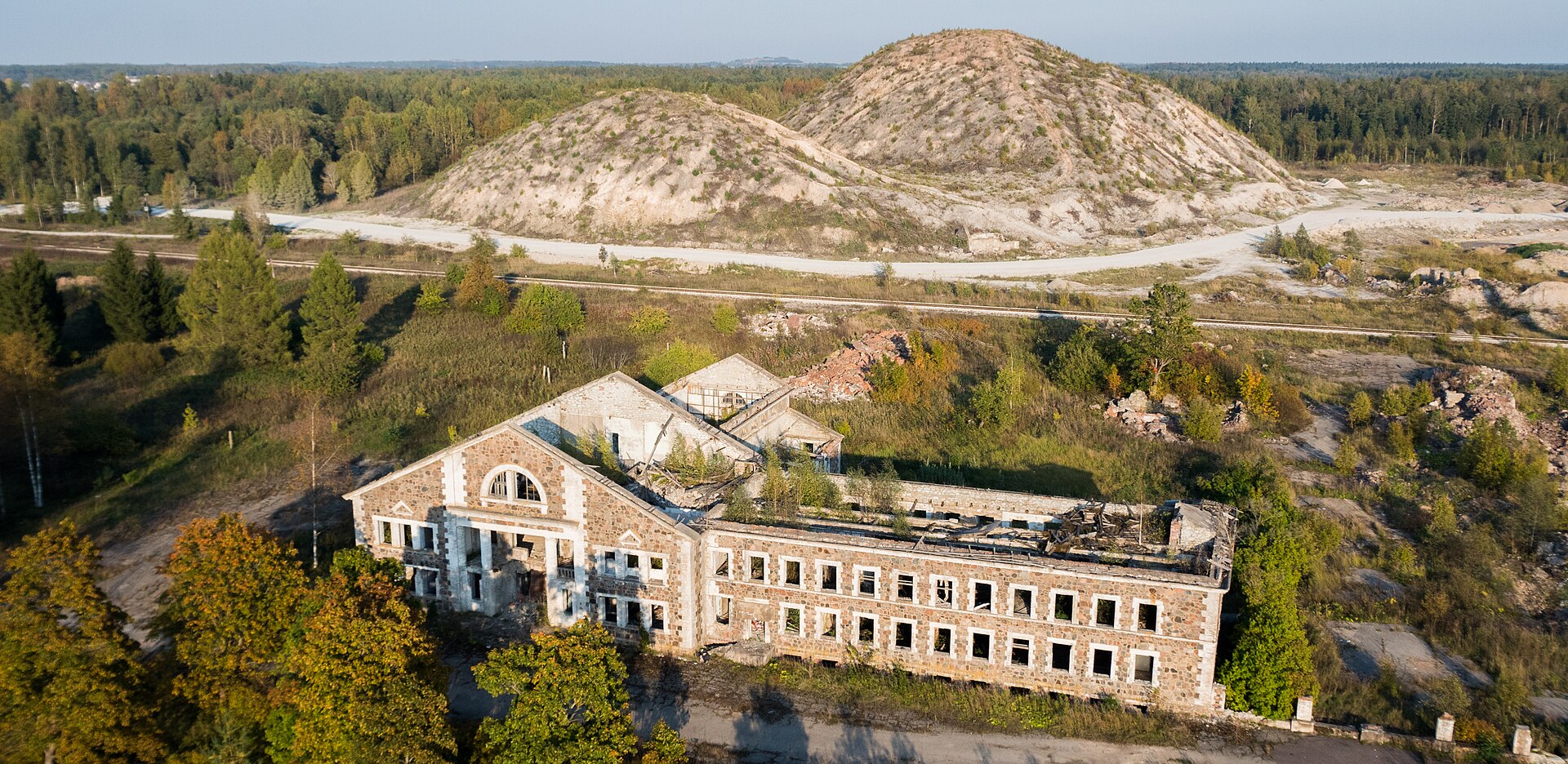
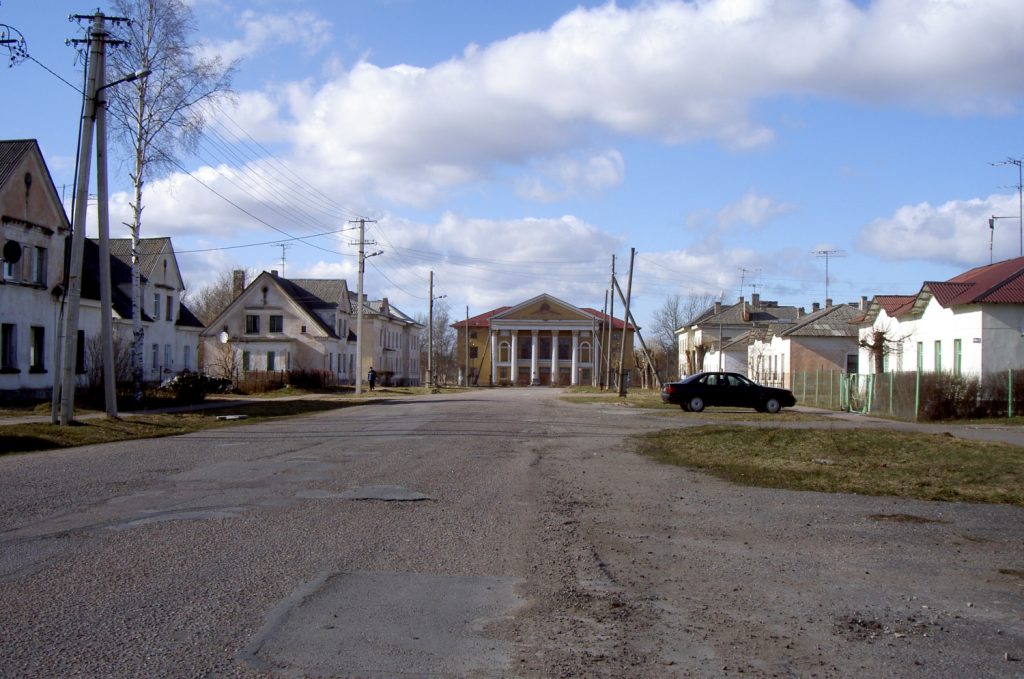
The north-easternmost of Estonia’s fifteen counties, Ida-Virumaa, is often seen as distinct and other by the rest of the country. Part of this is simply due to demography: the most recent statistics show that Ida-Virumaa is 73% ethnic Russian and just 18% Estonian, in a country whose population is almost 70% ethnically Estonian overall. But, while also having large stretches that are highly rural, it’s also the most industrialised part of the country – mostly due to the extensive deposits of oil shale, first noticed in the region in the 18th century (Estonia is the only country in the world where oil shale is the primary source of fuel). The intense destruction of World War II, when Ida-Virumaa was the scene of several titanic battles between the Nazis and Soviets, and the Soviet deportations that followed caused many of the original inhabitants to leave, and the consequent further intensification of industrial development by the Soviets drew many people from various other parts of the USSR, increasing its already comparatively high level of ethnic and cultural diversity.
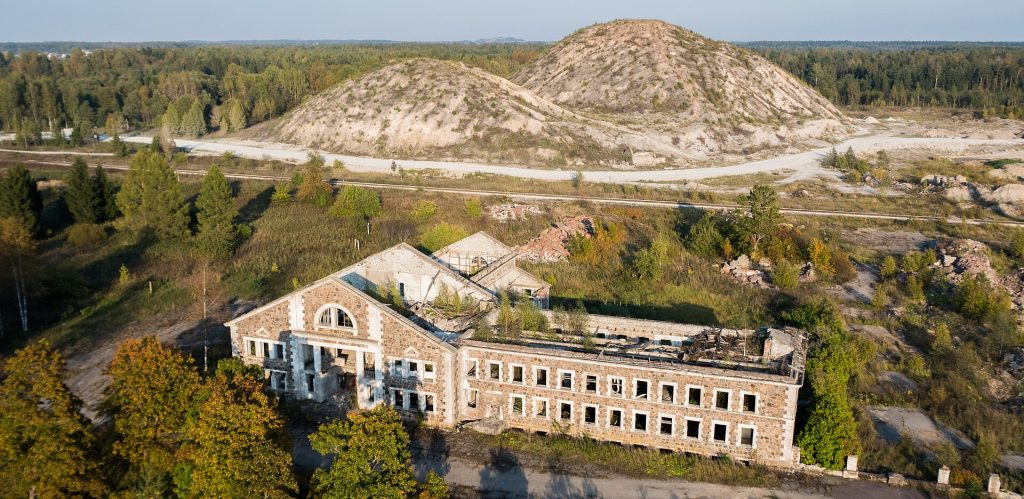
The Spanish-born, Estonian-based anthropologist Francisco Martínez has been travelling to and studying the region for many years, and a book reflecting this fieldwork in the county was recently published by Cornell University Press, entitled The Future of Hiding: Secrecy, Infrastructure and Ecological Memory in Estonia’s Siberia. The book examines the material consequences of this century and more of extractive activity, zeroing in on topics including so-called “ghost towns” such as miners’ settlement of Viivikonna, where virtually all of the population resident there a few decades ago have departed, as well as a state-directed demolition programme for Soviet-era accommodation in the nearby city of Kohtla-Järve, where more than 90% of housing was constructed since World War II (much now without permanent residents). Martínez focuses in particular on basements, sheds and other liminal or invisible private or semi-public spaces, showing how and why old possessions are preserved by residents and the way this can contradict or unsettle official narratives. The book demonstrates the suspicion and alienation felt by many in the region following the restoration of Estonian independence according to – in their interpretation – an ethnocentric framework in which belonging is based to a large extent on native language, although shows as well that there is by no means a monolithic view of this subject among the inhabitants of Ida-Virumaa. Deep Baltic publishes a conversation between Marian Võsumets and Martínez about the themes raised by the book.
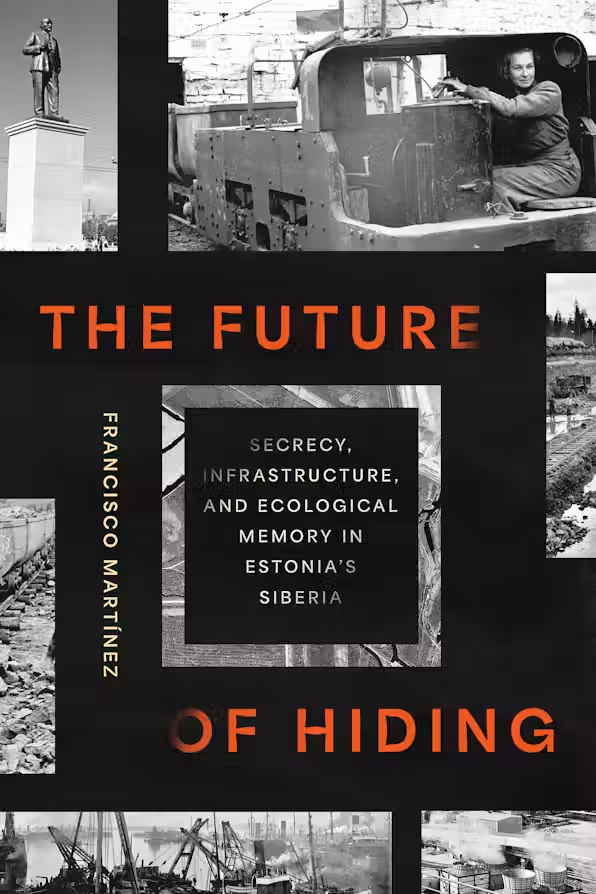
The Future of Hiding has a subtitle, which I find quite provocative, especially the last part of it about Estonia’s Siberia.
Ha! My friend Siobhan Kattago told me that this would be one of the questions for sure. So here it is, the first one.
As an Estonian, I’m obviously intrigued by this choice of words, because it’s not neutral…
The idea of Ida-Virumaa being like Siberia was pointed out by some of my informants. For example, teachers of the Estonian language who now move to Ida-Virumaa to work describe their experience as “moving to Siberia”, as if it were a place that feels like part of Estonia but not of Europe.
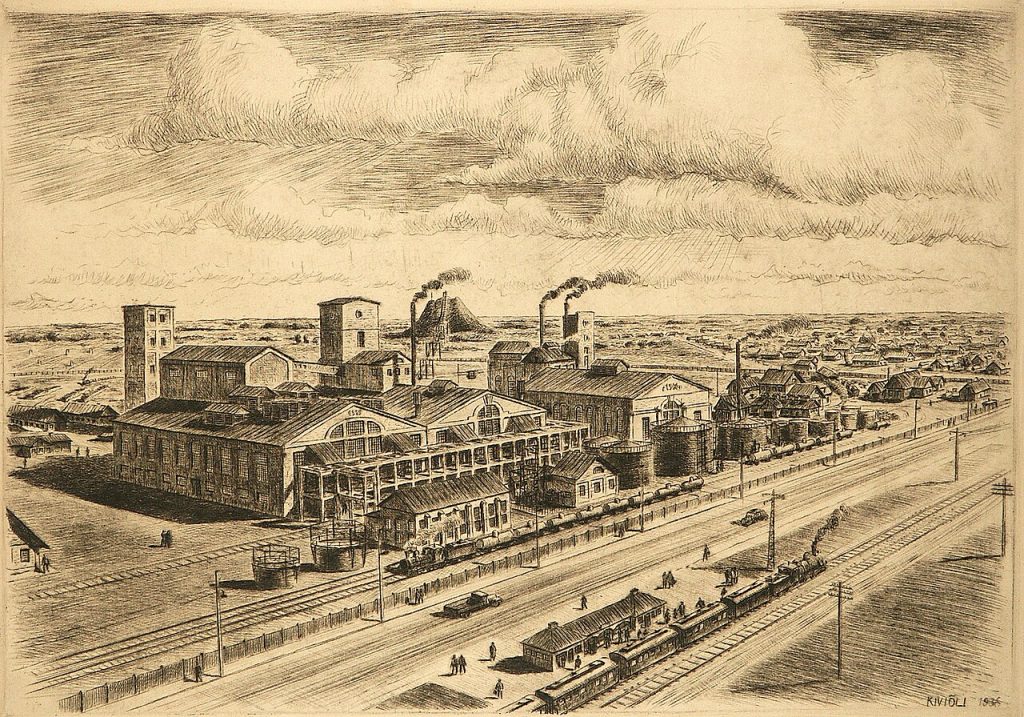
It also appears in diaries that I read about life in the region during the interwar period. In the 1930s, people referred it to as Siberia because of the economic opportunities that oil-shale mining generated. Since the government at the time had an agrarian stance and did not favour the migration of Estonians to newly urbanising cities, workers from other countries moved here. As a result, one could easily hear Finnish, Polish, Swedish or Latvian in places such as Kiviõli, Järve or Narva. Gangs were also formed and people carried firearms with them. Indeed, if a series like Peaky Blinders were to be filmed in Estonia, it would take place there.
But there’s a third reason. The marketing department of publishers prefer to have keywords in the subtitle that are easily identifiable on Google. Perhaps my favourite subtitle would have been something like “Tales from the Estonian East”. But the actual one also works because it grabs attention and gives rise to questions such as yours. Nonetheless, I’m aware of the waves of deportations to Siberia, how Ida-Virumaa was repopulated after the war, and that half of the original population was not allowed to come back. Interestingly, some of those who left, who escaped to Sweden or Canada, buried some possessions near their houses; they drew maps indicating where the holes were, hoping that at some point soon they’ll be able to return… but it only happened 50 years later.

I’m glad we got the Siberian topic out of the way…
Yeah, because the book has other layers. The first one, and most obvious, is the history of Ida-Virumaa, mostly focused on oil-shale mining, but also digging into uranium and also the processing of rare earth material, which is what’s happening now in relation to the half-completed European green transition and the new superbatteries factory.
The second layer describes how local people use hiding places to negotiate issues related to hybrid identity and complicated relations with different institutions; I mean how basements, garages, bunkers and dachas play a role in this alignment. And the third layer is a conceptualisation of Ida-Virumaa as the shadow of the national identity. The Estonian state has not been able to turn the heterogeneity of society into an asset, instead of a burden.
Let’s take a few steps back now and talk about the part that I find the most interesting about this book, which is indeed the hiding places.
Ida-Virumaa is a liminal region, so locals rarely identify with just one identity, and if they do so, it is in a rather performative way, depending on the context. I mean that the region is characterised by an abundance of connections and disconnections handled through ordinary practices. To edit their public persona, people use shadow-spaces where they can be at ease, where there is no need to perform any identity.
I’m not talking about escapism, but about negotiating how to be part of society. These hiding spaces extend the autonomy of local residents towards institutions, while allowing the possibility to expand their social life.
Many residents feel that they have to protect themselves from society in order to be part of society. This is not new, it was also present in the Soviet times and Tsarist Russia. But now, it is that if we think Estonia as a community, many of its members actively chose to ignore each other. The ignorance between one part of the society and the rest has been normalised. And everyone pretends this is OK.
So, to be clear, you do not mean hiding as disappearing, but as a space where you don’t have to explain yourself necessarily.
Exactly. For decades, there has been a passive-aggressive relation between the Estonian state and residents in the region; a kind of make-believe mutual ignorance, one side pretending to take care and the other pretending that they listen. But since the war in Ukraine started, local residents have been turned into a geopolitical problem, considered both a risk and a residue of the aggressive empire, notwithstanding what their views on the matter are.
The removal of Soviet monuments and of voting rights from those with grey passports, and the radical change in language policies in schools [starting in the 2024–5 school year, Russian-language education is being phased out in Estonia] have not contributed to making them feel part of this country. As a result, there is a sense of mistrust towards institutions. People tend to expect the worst from the state and from change, even if they desperately need both the state and change.
But your take on hiding places is also generative, not only defensive.
That’s correct. Places such as a garage, a dacha or a basement allow you to experiment with different sides of your personality. These corners facilitate the possibility of transformation. Their use shows that identity is something dynamic, something that we construct, sometimes in public, at other times silently and in the dark. For example, in basements we place the ideas and relations that do not fit in the present, without throwing them away. It is a way of playing lottery with the future. Ten years later, you might rediscover something that has now become vintage, or have the chance to show your son things belonging to your grandmother who came from Siberia, the kind of things you learned in a Soviet school, or the kind of music or cartoons you grew with.
Humans have always needed hiding places: spaces where we can momentarily suspend the normative rules of the society. These are spaces where the world loosens up for a moment. While no one is watching, we can rehearse other ways of being or transform ourselves. On the contrary, when you feel observed all the time, you stop asking questions and begin to seek conformity. This book defends the need to not always be available or visible.
These areas also allow the possibility of failure, right?
Yes, indeed. A garage or a dacha are like an artist studio or a laboratory. There you can experiment without serious consequences while ignoring the normative rules of the public game. In this light, the use of hiding places refers to our ability to protect personal autonomy.
But hiding places don’t exist only at the scale of the body or the home. Societies also construct their own shadow zones. There are entire regions that function as geopolitical basements: territories where unresolved conflicts, uncomfortable memories, and strategic resources that sustain visible life elsewhere are stored. Thereby, the book offers an unusual perspective on a key phenomenon of our time: instead of analysing visibility – so studied through surveillance and data – it shifts its focus to its opposite, the shadow, as an object of knowledge. It proposes understanding hiding places as necessary social infrastructures, where ways of life are tested and the relationship with power is negotiated.
In this context, opacity becomes an act of resistance.
I would not say resistance, but refusal. Shadow-spaces are not necessarily adversarial. Such areas resist the demand to be sorted into neat categories: occupier or liberator, Estonian or Russian, communist or European.
Due to how Estonian identity has been constructed since 1991 as a monolingual, ethno-nationalist state with a legal framework and historical narrative that is a continuation of the interwar republic, there is a sense of incomplete belonging in the eastern part of the country. Since independence, Estonia has pursued a nation-building project centred on language. For many ethnic Estonians, this represents a restoration of sovereignty postponed after decades of Soviet occupation. For many Russian-speakers, it means they are considered occupiers, remnants of an empire that no longer exists, and now, after the Russian attack on Ukraine, a geopolitical pawn.
But this fact, the sense of incomplete belonging, is not just because of ethnic reasons, but also due to the region’s own ecological memory, characterised by mining, deportations, industrial militarisation, and its position as a frontier between civilisations.
How did you get access to these private spaces?
Well, if the person sharing these kinds of opinions is my taxi driver, I try not to bother him because my life is in his hands. But, in other occasions, I could politely disagree or just leave the place.
I remember one occasion in Sillamäe when a person who was showing us his basement-bunker started to rant about our ignorance of what’s going on in Ukraine and who really started the war. Then, artist Anna Shkodenko sharply answered that the difference was that here, he could express this kind of opinion without fearing for his life, while on the other side of the Narva river you would end up in prison or beaten up for disagreeing with the hegemonic discourse.
I wonder what was the thing that you were really looking for with your research in these spaces?
At the beginning of my research, in 2018, I met Aleksandr Popolitov at the Sillamäe Museum and, while showing me his collection of old postcards, he asked “why is someone from Spain interested in us?” At the time, I was not able to provide a good answer and mumbled something about Soviet modernity. I continued getting that question over the years, so at some point I decided to turn it around and use it for my benefit, asking back “and why are you surprised that I show interest in this region?”
I did not always know what I was searching for, nor totally understood what was going on. And I do not mean in terms of language, but more about my own epistemic limitations. Then I realised that there is a deeper reality that is not always visible and plays a very important role in how the society is organised here. Like the submerged side of an iceberg.
If one of the people you talked with was to pick up this book today and read it, would they be surprised by your ideas or rather agree with your interpretation?
Honestly, I think most of these people would be proud because their views have been heard and published with a good international publisher, Cornell University Press. The time they dedicated to me was not wasted. Indeed, I already got that kind of feedback by some of them while presenting my book in Sillamäe or giving an interview in Narva a few months ago. I guess that if they continue inviting me, there must be a sense of trust.
Did you manage to meet also with Estonian-speakers there?
Of course. Russian-speakers mostly live in cities, in buildings from the Stalin or Khrushchev time. And many Estonian-speakers live in more rural areas, perhaps because their properties were returned to them in the 1990s. So the urban/rural divide in relation to ethnicity is very interesting. But, to my surprise, in the use of basements or dachas, the biggest difference was not ethnic, but generational. Elder people use these spaces in a more attentive way than younger people.
The book has a dreamy atmosphere, one gets carried away with the writing, which is romantic and passionate, with you very present in the descriptions.
I guess you mean this as a compliment, because I was rather careful not to romanticise things at the region. I made a lot of effort to make the book accessible to readers with different backgrounds. Also, the use of the self is typical of anthropological research, as we create relations with people in order to study wider social relations.
When I started writing it, I had just moved back to Tallinn after working in Finland and England. Indeed, I had bought an apartment and was trying to find my place in this society as a permanent resident. So I turned my own personal discomfort into a social investigation. When I visited other people’s basements and garages, I often left with the suspicion that I had gone there to hide something myself, something that I could not name. Based on this experience I learned that patience is a form of intelligence. Not everything has to be resolved immediately, not everything has to have a clear answer.
I have lived abroad half of my life, so my sense of identity is rather complex. In my effort to understand people in Ida-Virumaa, their incomplete sense of belonging and complex identity, I identified with them. As a result, I felt at home there. After visiting Ida-Virumaa at least once a month for five years, when I pass Purtse, the mental boundary of the region, I relax and think: home again.
Do you consider this book a portal into Ida-Virumaa?
Readers will understand where the current situation comes from and be able to see meaningful connections between things that had not been previously linked. Like how the extractivist history sets the frame for a difficult relation to institutions and limits our capacity to imagine alternative futures for this region, for instance.
I would be happy if the book contributes to make the perception of Ida-Virumaa less negative and also if readers understand that there are many ways of being Estonian. I saw that this society is not as homogeneous as the media and the government depict it. But this diversity is still presented as a burden because of how the current Estonian identity has been articulated.
However, many of the people I talked with feel a strong connection with their own territory and this country, even if in their own way, and despite the mineshafts, chemical stench, institutional mistrust and the neglect by the rest of Estonia. But the book is not only about Ida-Virumaa. Some of these ideas relate to human condition at large. Secrets make us human and they do not disappear once we are part of digital societies.
And why is the perception of the region so negative?
Well, the whole book is an answer to that question. But, in short, because of the ecological memory of the place, its past and present mining and military uses, and how Estonian identity has been constructed since 1991.
What other book about Estonia would you recommend?
In literature, The Master of Kõrboja (“Kõrboja peremees“) by Anton Tammsaare, Treading Air (“Paigallend“) by Jaan Kross, The Compromise (“Компромисс“) by Sergei Dovlatov, and The Man Who Spoke Snakish (“Mees, kes teadis ussisõnu“) by Andrus Kivirähk. In social sciences, the best in my opinion is Everything is Wonderful: Memories of a Collective Farm in Estonia, by Sigrid Rausing.
One last question, which are your future projects?
Personally, my goals are to know myself, be loved and save the world. In that order. Professionally, I just finished a new draft about collective feelings of crisis, hybrid threats, and new forms of materiality in the Baltic region. I intend to finish this manuscript at the Remarque Institute of the NYU, where I’ll be a visiting fellow until the end of the year.
Francisco Martínez’s The Future of Hiding: Secrecy, Infrastructure and Ecological Memory in Estonia’s Siberia is available now from Cornell University Press
© Deep Baltic 2026. All rights reserved.
Like what Deep Baltic does? Please consider making a monthly donation – help support our writers and in-depth coverage of Estonia, Latvia and Lithuania. Find out more at our Patreon page
