
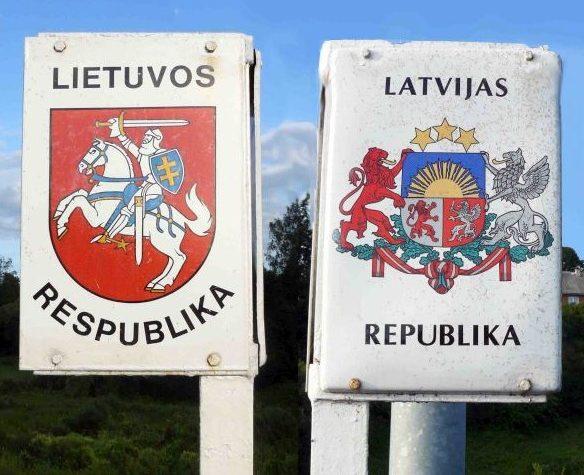
Latvian and Lithuanian are the two major surviving languages from the highly idiosyncratic Baltic family – a third member, Old Prussian, fell out of use in the 18th century. Some consider variants like Samogitian and Latgalian to be separate, though closely related languages, but they currently only have regional significance. While the two languages combined are spoken by no more than five million people, they are of huge interest to linguists because of their unusually conservative nature – which, in the context of linguistics, mean they change extremely slowly. This is especially true of Lithuanian, which preserves many features thought to have been characteristic of proto-Indo-European – the single language that was the ancestor of the great majority of the tongues spoken in modern-day Europe.
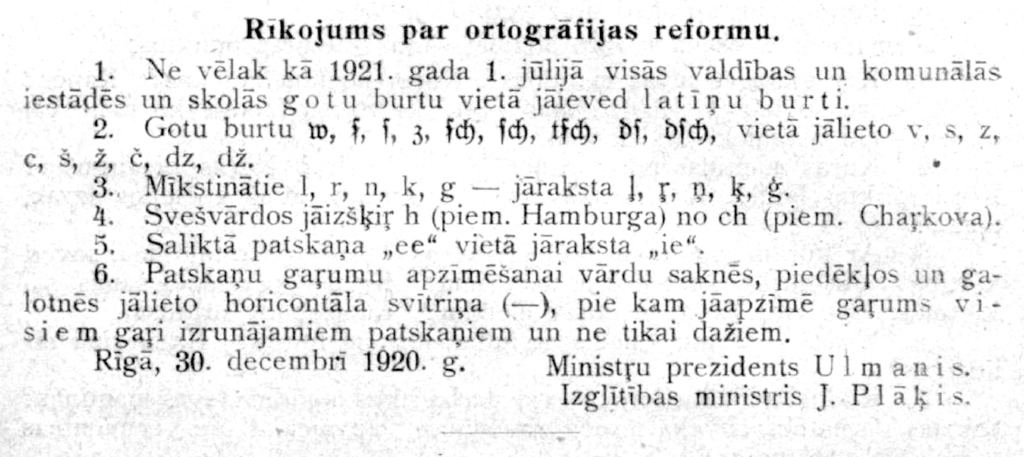
Although both Lithuanian and Latvian belong to the East Baltic cluster (all of the West Baltic languages, including not only Old Prussian but languages such as Skalvian, Galindian, Yotvingian and (possibly) Curonian, are now extinct), they are not mutually intelligible. The two countries have had very divergent histories, with Latvia having a closer historical experience to that of its northern neighbour Estonia (speakers of a Finno-Ugric language), with which it shares a history of German domination and a largely Lutheran faith, while Lithuania’s is closely intertwined with Poland and neighbouring Slavic-speaking countries. This can be seen in how the diacritics and orthography of the two languages have changed over time: after becoming independent for the first time in 1918, Latvian reformed the orthography to minimise German influence, while in the 19th century Lithuanian abolished the letter “ł” (still used in Polish), and replaced the digraphs “sz” and “cz” with “š” and “č”.
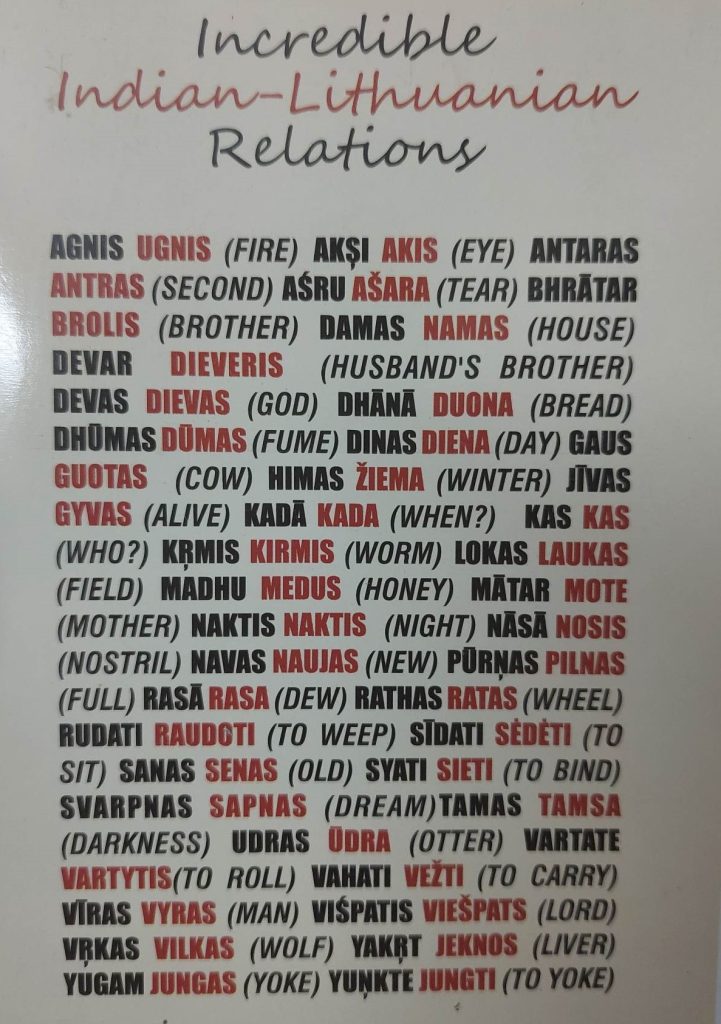
As the two tongues are too distant to be mutually intelligible – although speakers of Latgalian in eastern Latvia, and Samogitian in northern Lithuania may find it somewhat easier to comprehend the neighbouring language – Balts generally have to resort to a common lingua franca (under the Soviet occupation of the region, generally Russian, increasingly English) when visiting each other’s countries. While it’s unusual for people to learn both languages, Deep Baltic has managed to round up a few people who have attained some level of fluency in Latvian and Lithuanian to share their impressions about the similarities and differences between the two.
SAULĖ KUBILIŪTĖ
From: Vilnius, Lithuania. Based: Tampere, Finland.
At the time I was learning Latvian, I had nothing to do with languages or linguistics as a field, so my observations about the language were pretty silly – to the point I would make random connections between ‘bija grūti‘ (“it was difficult” in Latvian) and “bijau griūti” (“I am afraid to fall”, in Lithuanian). Perhaps the first thing I noticed was such phonetic differences like gegutė being dzeguze [“cuckoo” in Lithuanian and Latvian respectively], girdėti being dzirdēt [“to hear”], koja being kāja [“leg”] etc.
Something that I had to learn by practising was different use of cases. Latvian has a much stronger presence of the accusative and dative case, while in Lithuanian the genitive plays a bigger role. I had no teacher, so I was learning by observing. The similarities can still confuse me at times, for instance in digits I may have to swap the consonants to get the number in the other Baltic language.
I got way more interested when I started learning Estonian and began to notice all the not-so-obvious similarities between the two, like māja – maja [“house” in Latvian and Estonian respectively], etc. I think you really have to learn all three of the languages of the Baltic states to appreciate how special the Latvian language really is. It’s like a bridge, connecting Estonian and the Finnic family and Lithuanian and Baltic/Indo-European languages.
Not really about linguistics (but then again – what are languages without culture?), but the Latvian attention and love to someone learning Latvian, the encouragement can get even overwhelming. Since Latvian, I have studied Estonian, Māori, Swedish, and am currently learning Finnish, and I have never experienced anything like it. The efforts to attract people to the Latvian cultural realm, which is small but so special nonetheless, including the excellent campaigns to promote Latvian literature – I think it’s great and something that Lithuanians could learn from too. Latvians may seem reserved, but they do have a big heart.
SNORRE KARKKONEN SVENSSON
From: Oslo, Norway. Based: Riga, Latvia.
I started to learn Latvian while living for a year in Latvia as an exchange student during secondary school. I was already fluent in Latvian when I started to study Baltic philology at the University of Latvia. There the Lithuanian language was one of the compulsory subjects. I felt it was difficult to get into the language, and it felt so different from Latvian despite sharing so many words and grammar features. I guess my struggle also had something to do with my first Lithuanian language teacher, who liked more to chat and, when actually teaching, used quite ineffective methods. It was only after a summer course at Vilnius University that I felt I had some grasp of the language. Later, I used Lithuanian speaking with my friends and later achieved a level good enough to translate to Norwegian from Lithuanian.
Despite knowing the language quite well, still after all these years it feels a bit alien to me. Even more than Estonian, which is not related to Latvian and which I know at a lower level. I have got used to Lithuanian pronunciation, which is very different, but some of the way how things are expressed and even categorised differently in the two languages feels odd. Like how the passive tense is expressed or the sign in shops expressing thanks for buying: ačiū, kad pirkote (literally “thanks for that you were buying”) in Lithuanian and paldies par pirkumu (literally “thanks for the buy”) in Latvian. Lithuanian also has some fascinating verb forms that Latvian lacks (nebera – “is not anymore”) that are pretty cool.
So why does Estonian somehow feel closer to me even though Lithuanian is so closely related to Latvian? The reason is obvious if we look at history: Estonian and Latvian, similarly to my native Norwegian and the other Scandinavian languages, are languages that have been heavily influenced by (Low) German and are a part of a common North European culture area with North German influence due to politics and influence in society and culture. Traditionally, there is usually more focus on genetically related languages than so-called Sprachbunds, of which the Balkan languages are maybe the most famous in Europe, but Estonian and Latvian form the core of the Circum-Baltic languages.
CHRIS BUTLER
From: Nottinghamshire, England. Based: Vilnius, Lithuania.
Lithuania was the first Baltic country I visited, is where I have lived for more than 25 years and it is the Lithuanian language I speak fluently. Latvia was, however, the country I first relocated to when I first left London and consequently was the first Baltic language I tried to learn.
Whilst based in Latvia, I took Latvian lessons and acquired the basics to use in relatively simple social situations. My first reaction to learning the language was that it was not as difficult as everyone said it would be, due to two things – the regular structure of an inflected language, (familiar to anyone who has studied Latin), and the phonetic orthography. When I moved to Lithuania and started to learn Lithuanian, I was delighted to find that both of these things still held true, so my newly acquired knowledge was not at all wasted.
What I immediately noticed though, is that in Latvian you have the advantage that the stress is practically always on the first sylable, which gives Latvian (to my ear at least) its distinctive sound. In Lithuanian the stress is all over the place and I still make mistakes – as do many Lithuanians with certain words. Sometimes the language guardians even change (or at least publicise) the rules – some years ago the month of May (gegužė) went from an almost universally used second-syllable stress to a first-syllable one.
Most people warned me that the case endings (the same seven cases in both languages) are the most difficult things to get right. My experience with Lithuanian has been different – I find the verbal prefixes more difficult because they deliver subtly different meanings and sometimes even the same prefix gives a different meaning depending on the context. The case endings are by and large regular, so once you learn them, you’ve learned them and can use them. I still make mistakes – especially with the accusative for some reason – but overall my percentage of correct usage is pretty good.
When I listen to Latvian spoken these days I can hardly understand any of it, but when I see it written I can often get a sense of it due to the shared vocabulary, albeit through a glass darkly. Latvian definitely “wins” in terms of the number of diacritical marks, Lithuanian probably “wins” in terms of the smaller number of international borrowings. Latvians used to tell me that Lithuanian “sounds Polish” due to lots of š sounds, Lithuanians think Latvian sounds like Lithuanian spoken with an Estonian accent.
As an aside, one of the barriers to learning a Baltic language well is that Latvians and Lithuanians are simply not accustomed to foreigners learning their languages – this was especially true back in the ’90s/’00s. Clearly this is the result of history – all landowners and occupiers through the centuries force you to learn their language and not the other way around. For this reason it was a great help finding some friends who did not speak English at all and therefore were not constantly telling me that Lithuanian is “too difficult to learn”.
JOHANNA LOHRENGEL
From: Lower Saxony, Germany. Based: Launkalne, Latvia.
I first started learning Lithuanian, so by the time I learned Latvian it felt very familiar. But Lithuanian was like a completely new world to me. I was naive and uneducated and somehow imagined Lithuanian to be one of the Slavic languages when I first came there in 2010. I think this was one of the main surprises for me.
The first couple of months I did not understand a single word, because it had seemingly nothing in common with the other languages I had learned before (German, English, French, Malay, bits of Mandarin, even Esperanto). It felt old in a way and oddly funny with all the –as endings. As soon as I started recognising some words in conversations, I realised that the syntax is very different from my mother tongue, German, and much more flexible. Instead of relying on the structure of sentences [to express meaning], their case system is very elaborate. As a nerd for languages I found that very exciting to get into, but it makes it harder to just start speaking it once you know some words. I remember how it just seemed too hard for some of the other foreigners around me. But once you get to the point of understanding more, you notice how cute and playful Lithuanian is, especially with the endless opportunities for using the diminutive.
While Lithuanian, to me, sounds like the chirping of little birds and you absolutely never know which syllable to stress, Latvian, whose stress rules are as stable as their love for potatoes, sounds much more calm and slow. Latvian felt a bit more intuitive to me, but that might have to do with the incorporation of much more vocabulary from German than in Lithuanian. If I did not know the geography and would need to guess which of the two languages is spoken in the country further north, I would choose Latvian, as the rhythm resembles the singsong of other Nordic languages. Lithuanian still feels a bit more playful, a bit more jumpy and overall, more archaic to me. Both are fascinating, melodic languages that perfectly reflect the local cultures and landscapes.
This little fellow here had to learn how to properly roll the “r”, and that took her quite a while. Otherwise I had the luck (in hindsight) to be thrown into certain settings with people who did not speak English well, so I had no other choice than to learn it. As an auditory learner, it was relatively easy for me to catch up with the basics and start talking, but writing is still a big issue, as I never learned how to actually spell the words I heard. Also, when you speak it is possible to mumble a bit at the end of words, so that they cannot hear your incorrect grammar…
Honestly, even after living in Latvia for 10 years, and speaking it daily, I still feel uncomfortable using Latvian in a more academic setting. Learning these languages well enough only took me a year or so, but learning them well might take decades. I was able to dive into the world of the only Baltic languages that are still alive and they feel a little like a window to another world, a bit like a time machine.
ELĪZA PAULA GRAUDIŅA
From: Rundāle, Latvia. Based: Vilnius, Lithuania.
Growing up near the Lithuanian border, I visited Lithuania quite often with my parents. As a child, however, I did not particularly like the sound of the language. To me, it seemed very soft and somewhat reminiscent of Slavic languages, which at the time I did not feel drawn to.
My perspective changed completely once I began studying Lithuanian at university and immersing myself in Lithuanian music and culture. Gradually, I fell in love with the language. The same softness that had once irritated me began to feel warm and melodic – even charming. What I had perceived as a weakness became one of its most distinctive and appealing qualities.
In comparison to Latvian, Lithuanian feels like a distant cousin. At first glance, there are recognisable similarities, but mutual understanding is not automatic. Without spending time engaging with the language, it is difficult to truly understand it. However, once you do invest that time, you begin to see how closely related the two languages are, both in vocabulary and grammar.
Very often, when I cannot recall a word in Lithuanian, my friends encourage me to say it in Latvian – and surprisingly often, the words turn out to be identical or very similar. These moments highlight both the closeness and the subtle differences between the two Baltic languages.
For a long time, the most challenging part was the fear of making mistakes. I had reached a point where I could understand quite a lot, but I was convinced that I could not say anything beyond the five carefully memorised sentences I had prepared for my university exam.
Everything changed when I kept finding myself in situations where I simply had no choice but to speak Lithuanian. It was uncomfortable and challenging at first, but it became a turning point. I realised that I could express myself – even if I did not know every word or used the wrong ending. Overcoming the fear of making mistakes was truly game-changing. I understood that mistakes do not really matter as long as communication happens and people understand you. The only way forward is to keep speaking and not retreat into silence.
Now, after five years with the language and feeling fluent enough to use it in my everyday communication and academic work, a different challenge remains: correct word stress. Lithuanian accentuation is famously complex – even for native speakers. If it is already demanding for Lithuanians themselves, one can imagine how much of a “mission impossible” it can feel like for foreigners who aim to master the language as accurately as possible.
One of the first things that surprised me was the different historical influences on Lithuanian and Latvian. As a child, I had the impression that Lithuanian sounded somewhat similar to Slavic languages – and in a way, I was not entirely wrong. There are indeed words in Lithuanian that resemble Ukrainian or Polish vocabulary, words that simply do not exist in Latvian. At the same time, Latvian contains a significant number of loan words from German due to its historical ties, and these are largely absent in Lithuanian. Although Lithuanian and Latvian are the two closest living Baltic languages and share a common origin, their vocabularies clearly reflect different historical contacts. Being “in between” the two languages allows me to notice these contrasts much more clearly and to appreciate how each language carries traces of distinct cultural influences.
Another thing that surprised me was the richness and vitality of Lithuanian dialects. The variety is impressive, especially compared to Latvia, where dialects are fewer and not as widely used in contemporary cultural production. I find Lithuanian dialects incredibly beautiful, and I truly admire how present they are in literature, music and other art forms – not just preserved, but actively celebrated as part of cultural identity.
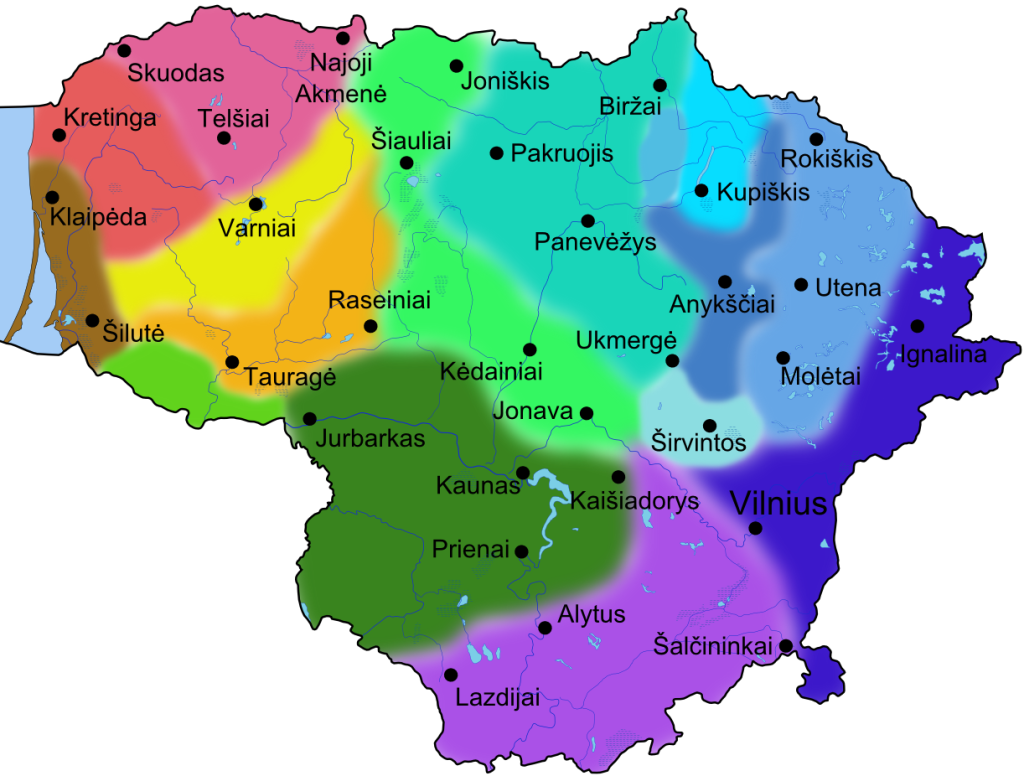
Map of the dialects of Lithuania proposed in 1965 by linguists Zigmas Zinkevičius and Aleksas Girdenis [Image: Renata3, used under a CC BY-SA 3.0 Licence]
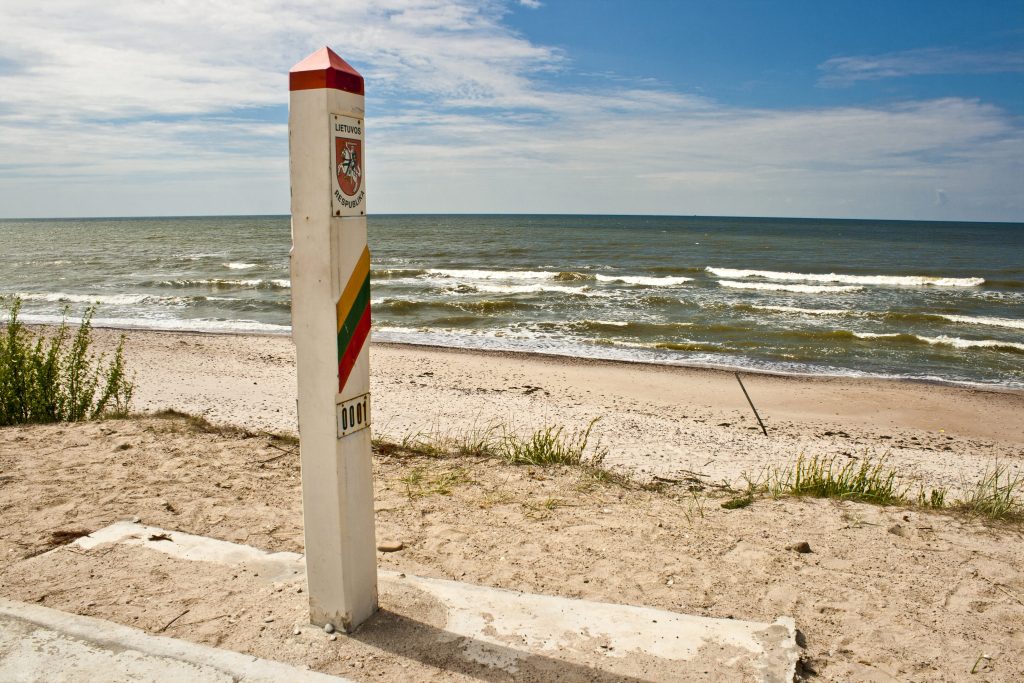
Header image – alkas.lt
© Deep Baltic 2026. All rights reserved.
Like what Deep Baltic does? Please consider making a monthly donation – help support our writers and in-depth coverage of Estonia, Latvia and Lithuania. Find out more at our Patreon page

